
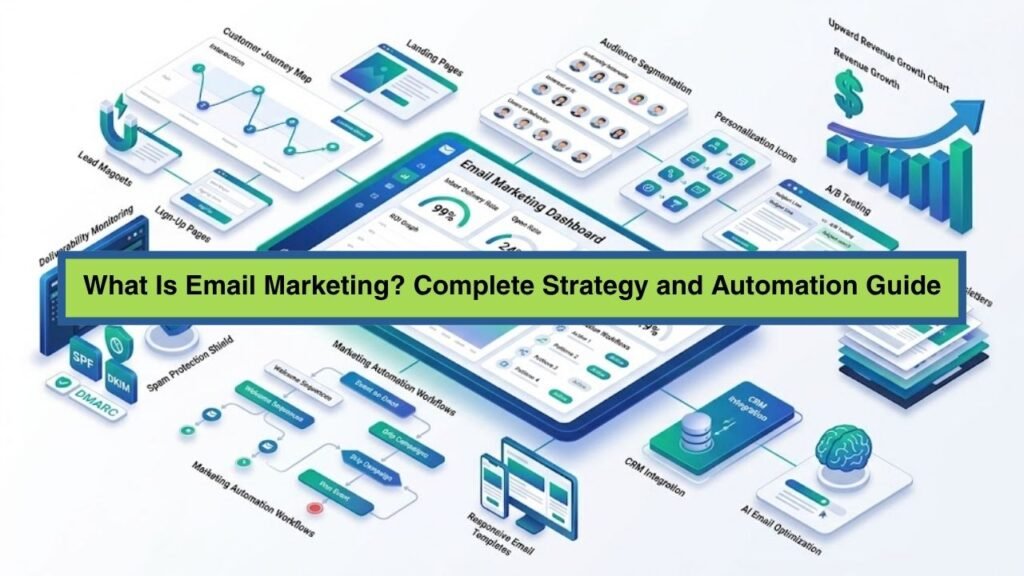
Email marketing is the practice of sending targeted messages to people who’ve given you permission to contact them, with the goal of building a relationship and driving some kind of action — a purchase, a sign-up, a return visit. It’s also one of the only marketing channels a business fully owns: no algorithm decides who sees your email, and no platform can shut off your access to your own list.
That distinction is worth sitting with for a second, because it’s the reason email has outlasted a dozen “email is dead” predictions since the format was invented.
What Is Email Marketing? (The Direct Answer)
Email marketing is a form of digital marketing that uses email to promote products or services, share information, and build relationships with an audience that has opted in to receive messages. It covers everything from a single promotional blast to an automated, multi-step drip campaign, and it’s typically run through dedicated marketing automation platforms rather than a personal inbox.
The rest of this guide breaks down how that actually works, what it costs, and where most businesses get it wrong.
Why Email Marketing Still Works
Email Is a Channel You Own, Not Rent
Social media reach depends on an algorithm that can change overnight. Paid advertising stops the moment the budget runs out. An email list is different — once someone subscribes, that relationship exists independently of any third-party platform’s decisions. Even if you switch email service providers, the list itself moves with you.
The Real ROI Numbers Behind Email Marketing
Industry figures on email marketing’s return on investment vary by source, typically landing somewhere between $36 and $42 for every dollar spent. Those numbers get repeated often enough to lose meaning, so treat them as a directional signal rather than a guarantee — actual returns depend heavily on list quality, segmentation, and how relevant the content actually is to the person opening it. A poorly targeted campaign to a stale list won’t come close to those averages, no matter what the channel-wide statistic says.
Email vs. Social Media vs. Paid Ads — Where It Fits
Email sits differently in a marketing mix than either social media marketing or paid advertising. Social media is built for discovery — reaching people who don’t know you yet. Paid ads buy immediate visibility, the same way SEO builds it slowly through organic search. Email is best at the stage after that: nurturing someone who’s already shown interest, toward an actual decision. As a form of direct marketing, it shares more in common with inbound marketing than with cold outreach — the recipient asked to be there. Most effective digital marketing strategies treat these as complementary rather than competing, with email doing the quiet, ongoing work the other channels aren’t built for.
The Different Types of Marketing Emails
Not every email in a strategy serves the same purpose, and mixing them up is one of the more common mistakes businesses make.
Newsletters are recurring, content-first emails meant to keep a business top of mind between purchases — company updates, industry news, or curated content, sent on a predictable schedule.
Welcome emails, often part of a larger onboarding sequence, greet a new subscriber immediately after sign-up. This is typically the highest-engagement email a business ever sends, since the subscriber’s interest is freshest right after they opted in.
Promotional emails exist to drive a specific action — a sale, a limited-time offer, a new product launch. These are the most overtly sales-focused type, and the ones most likely to get a list fatigued if sent too often.
Lead nurture emails guide a prospect who isn’t ready to buy yet toward a decision as part of ongoing lead nurturing, usually through an automated sequence tied to where someone sits in the buyer journey.
Re-engagement emails, sometimes called win-back emails, target subscribers who’ve gone quiet — people who haven’t opened or clicked in months. A good re-engagement sequence either revives the relationship or, just as usefully, confirms it’s time to remove that address from the list.
Transactional Emails — And Why They’re Different
Transactional emails — order confirmations, password resets, shipping notifications — get lumped in with marketing emails constantly, and that’s a mistake worth avoiding. They’re triggered by a specific action a person took, not by a marketing calendar, and legally they’re treated differently: a transactional email whose primary purpose is completing a transaction generally doesn’t need an unsubscribe link, while a true marketing email always does. Mixing heavy promotional content into a transactional email can push it into “commercial message” territory in the eyes of regulators, which brings the full compliance requirements back into play. Keep the two separated, both in your platform’s settings and in your own thinking about what each email is for. This is distinct, too, from cold email — unsolicited outreach to people who haven’t opted in at all, which carries its own set of rules and a much higher risk of damaging sender reputation.
How Does Email Marketing Actually Work?
Building and Growing a List the Right Way
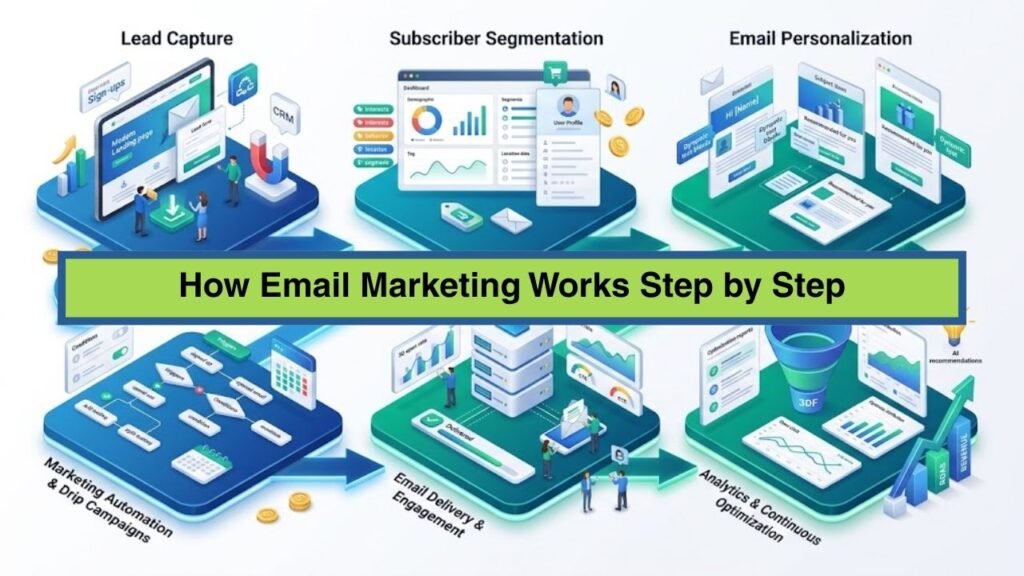
Every list starts with a sign-up form, usually attached to a landing page or a lead magnet — a free guide, discount, or resource offered in exchange for an email address. The mechanics matter here: a single opt-in adds someone to the list the moment they submit the form, while a double opt-in requires a confirmation click before they’re added. Double opt-in produces a smaller list, but a more engaged one, since every subscriber has actively confirmed interest twice.
Segmentation — Sending the Right Message to the Right Person
Segmentation means splitting an email list into smaller groups based on behavior, purchase history, or stated interests, then tailoring content to each group instead of sending one message to everyone. A list segmented by recent purchase behavior, for instance, lets a business send genuinely relevant follow-ups instead of a generic blast that half the list ignores.
Personalization Beyond “First Name”
Real personalization goes further than inserting a subscriber’s name into a subject line. It means using what you actually know about someone — what they’ve bought, what they’ve clicked, where they are in their journey — to shape the content itself, not just the greeting.
Marketing Automation and Drip Campaigns
Marketing automation platforms let a business set up a workflow once and let it run: a new subscriber triggers a welcome email, a specific click triggers a follow-up, an abandoned cart triggers a reminder days later. A drip campaign is the most common form of this — a pre-built email sequence that goes out on a set schedule after a defined trigger event, running in the background without a person needing to manually send each message.
A/B Testing Subject Lines, Content, and Send Times
A/B testing, also called split testing, sends two versions of an email — different subject lines, different preheader text, different call to action (CTA) placement, different send times — to small portions of a list, then sends the better-performing version to everyone else. Over time, this is how a program moves from guessing what resonates with an audience to actually knowing.
What Is Email Deliverability, and Why Does It Matter More Than Design?
Most guides to email marketing spend their time on subject lines and templates and barely mention the reason a well-crafted email sometimes never gets read at all: it never made it to the inbox in the first place.
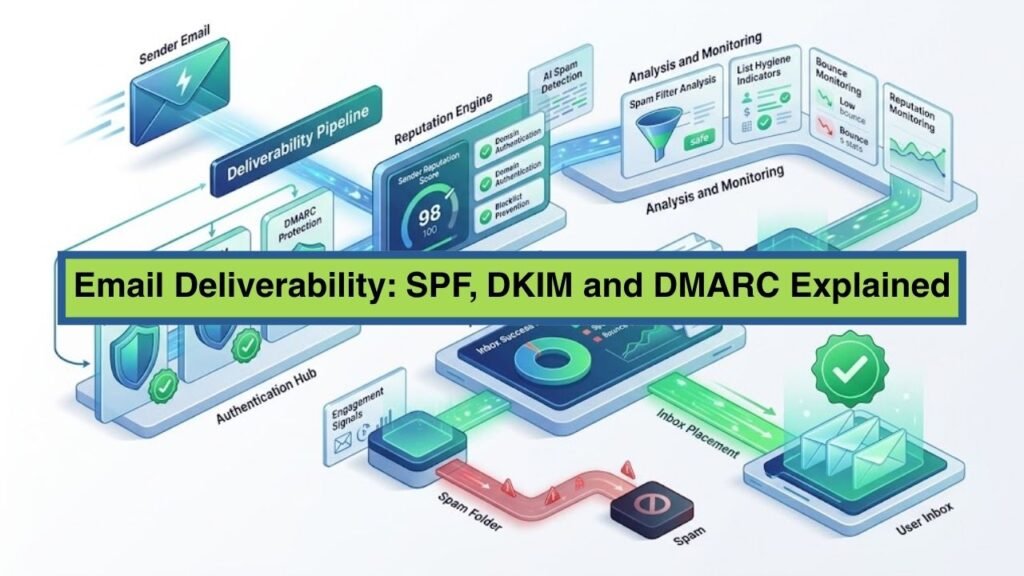
Email deliverability is the measure of whether your emails actually land where they’re supposed to — the inbox, not spam. It’s a separate problem from open rate, and it’s usually the real explanation when a campaign underperforms for reasons that seem to have nothing to do with the content itself.
SPF, DKIM, and DMARC — The Authentication Basics
Three technical records sit behind almost every deliverability issue. SPF (Sender Policy Framework) tells receiving mail servers which servers are authorized to send email on your domain’s behalf. DKIM (DomainKeys Identified Mail) attaches a digital signature to outgoing email, proving the message wasn’t altered in transit. DMARC builds on both, telling receiving servers what to do with a message that fails SPF or DKIM checks — reject it, quarantine it, or let it through. None of these require deep technical expertise to set up, but skipping them is one of the fastest ways for legitimate marketing emails to land in spam by default.
What Actually Lands an Email in Spam
Spam filters weigh a mix of signals: authentication status, sender reputation, engagement history, and content red flags like excessive exclamation points or spam-trigger phrases. A single email rarely gets flagged for one reason alone — it’s usually a pattern building over time, which is exactly why deliverability problems tend to creep in gradually rather than appear all at once.
Sender Reputation and List Hygiene
Sender reputation is a score, tracked by mail providers like Gmail and Outlook, that reflects how recipients treat your emails over time — opens, clicks, spam complaints, and bounce rate. A high bounce rate, whether hard bounces (permanently invalid addresses) or soft bounces (temporary delivery failures), drags that reputation down. List hygiene — regularly removing invalid or disengaged addresses — protects sender reputation the same way regular maintenance protects anything else that degrades with neglect. A smaller, engaged list consistently outperforms a larger, stale one on every metric that actually matters. [Internal link: /email-marketing/]
Email Marketing Compliance — What You’re Legally Required to Do
This section gets a single sentence in most guides. It deserves more than that, because the requirements are specific and the penalties aren’t theoretical.
CAN-SPAM Act Requirements (US)
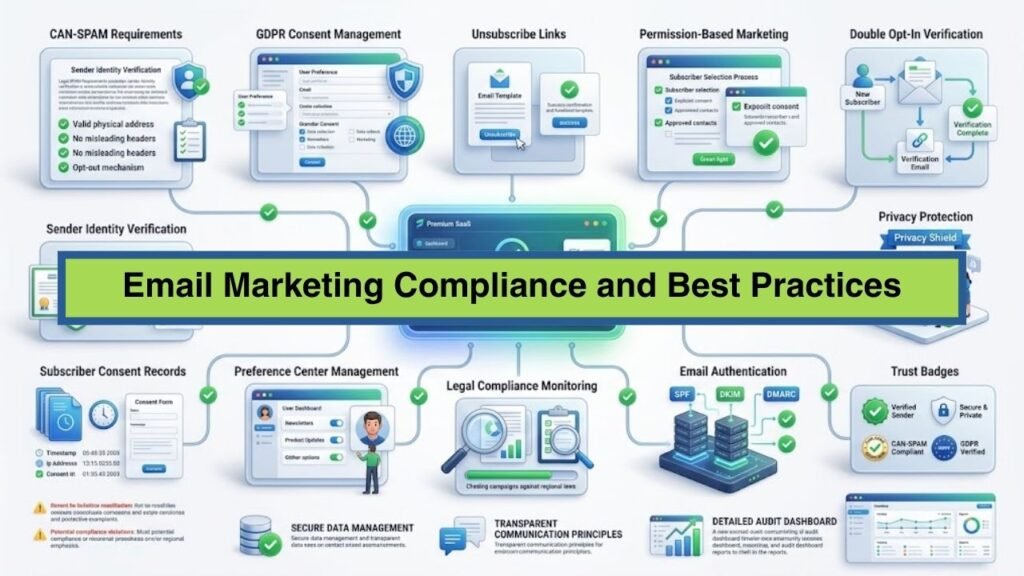
The CAN-SPAM Act governs commercial email sent in or into the United States, and — notably — it applies to B2B email exactly the same way it applies to B2C. According to the FTC’s own compliance guide, every commercial message needs accurate header information, a subject line that reflects the actual content, clear identification as an advertisement, a valid physical postal address, and a working opt-out mechanism. Once someone opts out, the sender has 10 business days to honor that request, and the opt-out mechanism itself has to remain functional for at least 30 days after the message was sent. Violations carry real financial penalties per message, not per campaign, which is what makes casual non-compliance a genuinely expensive risk rather than a minor oversight.
GDPR and Consent-Based Marketing (If You Have EU Subscribers)
GDPR takes a stricter approach than CAN-SPAM, generally requiring clear, affirmative, permission-based consent before adding someone to a marketing list at all, rather than allowing outreach until someone opts out. Any business with subscribers in the EU needs consent records that show when and how someone agreed to receive email, not just an unsubscribe link at the bottom of the message.
Opt-In vs. Opt-Out, and Why It Matters for Deliverability Too
Beyond the legal angle, opt-in quality directly affects deliverability. A list built through purchased addresses or scraped contacts — people who never actively opted in — generates far higher spam complaint rates than a list built through genuine sign-ups, and high spam complaint rates are one of the fastest ways to damage sender reputation across an entire domain, not just one campaign.
How Much Does Email Marketing Cost?
Email Service Provider Pricing (DIY)
Most email service providers price by list size and features, with several offering functional free tiers for small lists. Recognizable names in this space — Mailchimp, Klaviyo, Constant Contact, ActiveCampaign, Brevo, and MailerLite among them — each lean toward slightly different strengths, from ecommerce-focused automation to simpler newsletter tools, while larger platforms like HubSpot and Salesforce fold email into a broader CRM (customer relationship management) system for businesses that want marketing and sales data in one place. Paid plans commonly range from around $10 to $350+ a month depending on subscriber count and the sophistication of automation features included, and most come with a pre-built email template library and responsive design baked in so campaigns render correctly on mobile without extra development work. This makes email one of the lower-barrier marketing channels to start on a limited budget, especially compared to paid advertising, where cost scales directly with traffic volume rather than list size.
What an Agency or Freelancer Adds (and Costs)
Beyond the platform fee, the actual work — strategy, segmentation, copywriting, template design, deliverability troubleshooting — either falls to someone in-house or gets outsourced to a freelancer or agency. That additional cost varies widely based on send volume and complexity, but it buys expertise most small teams don’t have time to build on their own, particularly around the deliverability and compliance issues covered above.
How to Measure Email Marketing Success
Open Rate, Click-Through Rate, and Conversion Rate
Open rate measures how many recipients opened an email; click-through rate (CTR) measures how many clicked a link inside it; conversion rate measures how many completed the actual goal — a purchase, a sign-up, a download. These three metrics tell a funnel story, and a healthy campaign should show reasonable movement from one stage to the next rather than a steep drop-off at any single point.
Unsubscribe Rate and Spam Complaint Rate — The Metrics Nobody Talks About
Open rate and CTR get all the attention in most guides, while unsubscribe rate and spam complaint rate barely get mentioned — despite directly threatening a program’s ability to reach the inbox at all. A rising spam complaint rate is a leading indicator of a deliverability problem before it shows up anywhere else in the numbers, which makes it worth watching as closely as the metrics that feel more like good news.
What’s a “Good” Benchmark, Realistically
Benchmarks vary enormously by industry, list size, and email type — a small, highly engaged B2B list will often show open rates well above what a large consumer newsletter list sees, and neither number is inherently “better.” Rather than chasing an industry-wide average, the more useful comparison is a business’s own numbers over time: is click-to-open rate improving campaign over campaign, and is list growth rate keeping pace with natural list decay from unsubscribes and bounces.
Common Email Marketing Mistakes
- Buying or scraping an email list instead of building one. This violates the spirit of every major compliance framework, tanks sender reputation almost immediately, and produces a spam complaint rate that can damage deliverability for every future campaign sent from that domain.
- Sending the same message to the entire list every time. Skipping segmentation means every email is optimized for nobody in particular — relevant to some subscribers, irrelevant to most.
- Ignoring deliverability until it’s already a problem. SPF, DKIM, and DMARC are worth setting up before the first real campaign goes out, not after inbox placement quietly starts declining.
- Treating a welcome email as optional. Skipping the onboarding sequence wastes the single highest-engagement moment a business gets with a new subscriber.
- Never testing anything. Guessing which subject line or send time works best, instead of running A/B tests, leaves real performance gains on the table indefinitely.
- Confusing content marketing with email marketing. Email is a distribution channel for content, not a replacement for having something worth saying — a beautifully designed email with nothing useful inside it still gets ignored, unsubscribed from, or reported as spam.
Frequently Asked Questions
What is email marketing and how does it work?
Is email marketing still effective?
What is a good open rate for email marketing?
What's the difference between email marketing and email automation?
What's the difference between a marketing email and a transactional email?
How often should you send marketing emails?
What is CAN-SPAM and do I have to comply with it?
How do you build an email list from scratch?
What is segmentation in email marketing?
Why are my emails going to spam?
How much does email marketing cost for a small business?
Is It Time to Bring in Help?
A small list, a simple newsletter, and a free-tier platform is genuinely fine to run alone — plenty of businesses manage this well without outside help. The point where it starts making sense to bring in expertise is usually when segmentation gets complex enough to be time-consuming, when automation needs to coordinate across multiple workflows, or when deliverability problems show up and the cause isn’t obvious from inside the platform’s dashboard.
If that’s where things stand, a free email audit is a reasonable way to find out what’s actually happening with your current program before committing to anything bigger — whether you’re running a small list from a home office or managing email for a growing team in Houston, Texas. Get a free email marketing audit and see where your list and deliverability actually stand.