
If you’ve ever wondered why some websites magically appear on top of Google, while others (maybe even yours) get buried on page 10, you’re already thinking about SEO even if you didn’t know it. And trust me, once you understand SEO, the digital world starts making a LOT more sense.
Today, we’re diving deep into what is SEO in digital marketing, how it works, why it matters, and how you can start using it like a pro. And don’t worry, I’ll keep things friendly, conversational, and completely jargon-free. Think of this as two friends chatting over coffee about growing an online presence.
Let’s get into it.
What Really Is SEO and Why Should You Care?

Have you ever Googled something, clicked one of the top three results, and moved on with your life? Of course, you have because we all do. And that behavior is exactly why SEO matters.
SEO or Search Engine Optimization is the art and science of getting your website to appear higher in search engines like Google, Bing, and even YouTube.
When I first started digital marketing, I remember asking myself the same thing you might be wondering now:
“What is SEO and how does it actually work?”
Well, after years of experimenting, failing, learning, and ranking websites, I can tell you SEO isn’t rocket science. It’s simply about helping search engines understand your content and helping people find what they’re searching for.
And once you get a taste of how SEO boosts traffic, it becomes addictive IMO.
Let’s break everything down step-by-step.
What Is SEO in Digital Marketing?

At its core, SEO in digital marketing is the process of optimizing your website so it appears higher in search engine results pages (SERPs).
Think of search engines as giant libraries. Your website is a book, and SEO is how you make sure your book is placed on the front shelf — not hidden in the basement.
SEO Meaning in Business
In business terms, SEO means:
- More visibility
- More website visitors
- More leads
- More sales
- More authority
And the best part? SEO brings in free, organic traffic — unlike paid ads, where you stop appearing the moment you stop paying.
What Does SEO Stand For?
SEO stands for Search Engine Optimization — optimizing content for search engines while keeping humans in mind (the most important part).
What Is SEO in Digital Marketing With Examples?
Here are simple examples:
- Adding keywords like “best coffee shop in Dubai” to a blog about cafés.
- Improving website speed so Google ranks it higher.
- Getting backlinks from other websites to boost authority.
- Use structured headings (H1, H2) so Google understands your content.
How Does SEO Work?

Search engines use bots called crawlers to scan websites and index them. Then they use complex algorithms to decide which page deserves to rank highest.
Here’s the simple breakdown:
- Crawling
Google scans your website. - Indexing
Google stores your content in its database. - Ranking
Google decides where your page should appear in search results.
How Does Google Decide Ranking?
Google looks at hundreds of factors, but the main ones are:
- Relevance
- Authority
- User experience
- Content quality
If your site ticks these boxes, Google rewards you with higher rankings.
Types of SEO in Digital Marketing
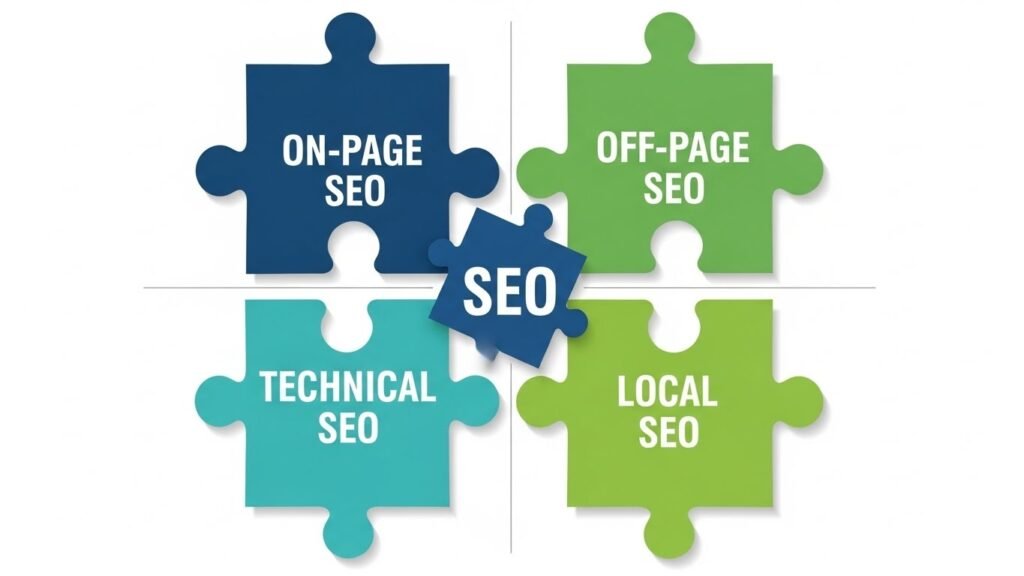
SEO isn’t just one thing — it’s made up of multiple layers. Think of it like building a house. You need a strong foundation, solid walls, a roof, and finishing touches. Same with SEO.
Let’s look at the main types.
1. On-Page SEO
On-page SEO focuses on what you can control inside your website.
Key Elements of On-Page SEO
- Keyword research
- High-quality content
- Proper use of headings
- Internal linking
- Image optimization
- Meta titles and descriptions
Example of On-Page SEO
If your keyword is “what is SEO in digital marketing,” you would:
- Add the keyword naturally in the article
- Create a catchy title with the keyword
- Use the keyword in headings
- Include synonyms like “SEO meaning in business.”
2. Off-Page SEO
Off-page SEO is everything you do outside your website to boost rankings.
Major Off-Page SEO Factors
- Backlinks
- Brand mentions
- Social signals
- Guest posts
- Influencer collaborations
Example: If a popular website links to your article, Google sees you as trustworthy, kind of like a digital vote of confidence.
3. Technical SEO
Technical SEO ensures your site is easy for search engines to crawl, understand, and index.
Important Technical SEO Factors
- Fast website loading
- Mobile-friendly design
- Secure connection (HTTPS)
- Clean URL structure
- XML sitemap
- Structured data
Example: If your site loads in 1 second instead of 5, Google prioritizes you.
4. Local SEO
Local SEO is perfect for businesses that rely on local customers.
Local SEO Includes
- Google Business Profile optimization
- Local keyword targeting
- Local citations
- Local backlinks
Example: Ranking for “best dentist near me” is a Local SEO win.
5. Content SEO
This focuses on creating helpful, valuable, search-optimized content.
Content SEO Includes
- Keyword-rich articles
- User-intent-focused content
- Helpful long-form guides
- Visual content optimization
How to Do SEO (Beginner-Friendly Guide)

If you’re wondering how to do SEO without feeling overwhelmed, here’s a friendly step-by-step guide.
Step 1: Do Keyword Research
Find what people are searching for.
Tools you can use:
- Google Keyword Planner
- Ahrefs
- SEMrush
- Ubersuggest
Look for:
- High search volume
- Low competition
- Keywords related to your niche
Step 2: Create High-Quality Content
This is the backbone of SEO. Google rewards content that helps users.
Your Content Should Be:
- Helpful
- Clear
- Well-structured
- Engaging
- Fact-checked
- Keyword-optimized
Step 3: Optimize Your On-Page Elements
Add your main keyword in:
- Title
- Introduction
- Subheadings
- Meta description
- Image alt text
Use internal links to direct readers to your other pages.
Step 4: Improve Your Technical SEO
Make your site fast and mobile-friendly.
Checklist:
- Compress images
- Enable caching
- Fix broken links
- Use HTTPS
- Submit sitemap to Google Search Console
Step 5: Build Backlinks
Backlinks are essential for ranking.
Ways to get backlinks:
- Guest posting
- Creating shareable content
- Collaborating with influencers
- Listing your business on directories
Step 6: Track and Improve
Use analytics tools to monitor your SEO progress:
- Google Analytics
- Google Search Console
SEO is not a one-time task. It’s an ongoing process.
SEO Examples (Real-Life Scenarios)

Let’s look at some simple, relatable examples.
Example 1: Blog Post Ranking
A blog post titled “Best Running Shoes for Beginners” gets optimized with the right keywords and backlinks. It slowly climbs up to Google’s first page and brings thousands of organic visitors.
Example 2: Local Business Ranking
A restaurant adds its details to Google Business Profile and receives positive reviews. Within weeks, it starts ranking for “best pizza near me.”
Example 3: E-Commerce SEO
An online store optimizes product descriptions and images. Suddenly, product pages start appearing on Google for top shopping keywords.
That’s the magic of SEO.
Importance of SEO in Digital Marketing
SEO is one of the most important pillars of digital marketing — and here’s why:
1. It Brings Free, Organic Traffic
You don’t pay for every click as you do with ads.
2. Builds Trust and Credibility
People trust Google’s top results more than anything else.
3. Improves User Experience
Good SEO means a fast, smooth, easy-to-navigate website.
4. Long-Term Results
Unlike paid ads, SEO keeps working for months or even years.
5. Helps You Beat Competitors
If you’re not investing in SEO, your competitors definitely are.
Conclusion: Ready to Level Up Your SEO Game?
SEO might sound complicated at first, but once you understand the basics, it becomes a fun and rewarding journey. And honestly, it’s one of the most powerful tools in digital marketing. Whether you’re a business owner, a content creator, or just someone curious about the digital world, knowing what SEO is and how it works gives you a massive advantage.
Remember:
- SEO isn’t about tricks — it’s about helping people find helpful content.
- It takes time, but the results are worth it.
- And yes, you can absolutely do it, even if you’re just starting.
So go ahead — start optimizing, experimenting, learning, and ranking.
Your future traffic will thank you.