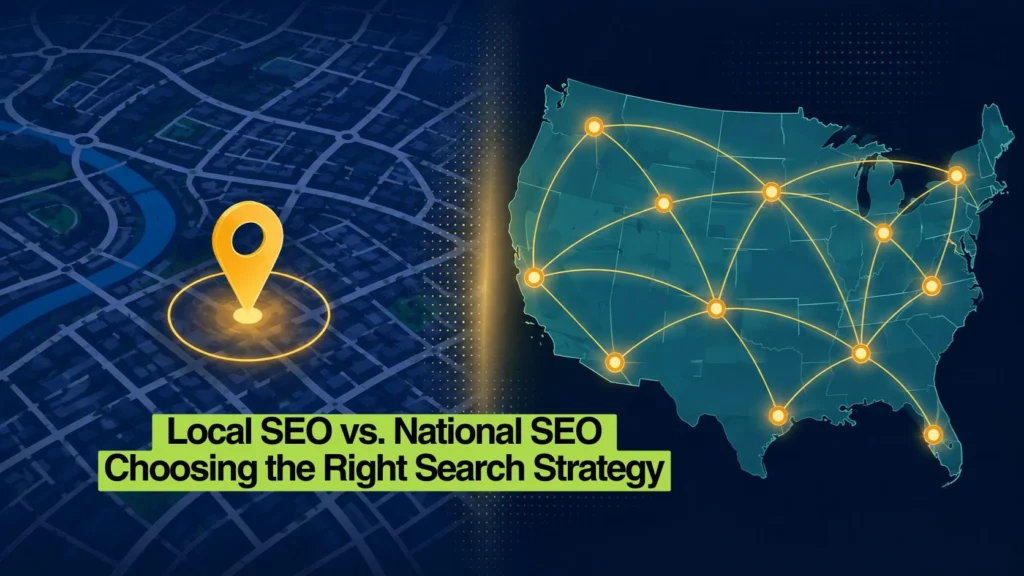
You’ve probably typed a search into Google today without thinking twice about it. Maybe it was “coffee shop near me.” Maybe it was “best CRM software for small teams.” What you may not have noticed is that Google treated those two searches completely differently — one triggered a map, pins, and a list of nearby businesses; the other pulled up a national field of competitors fighting for the same broad keyword.
That difference isn’t an accident. It’s the line between local SEO and national SEO — and understanding which side of that line your business sits on is one of the most consequential decisions you’ll make in your SEO strategy.
Get it wrong, and you’ll spend a marketing budget chasing the wrong kind of search visibility. Get it right, and you’ll show up exactly where your target audience is already looking.
This guide breaks down what each approach actually means, how they differ in practice, and — most importantly — how to figure out which one (or which combination) your business actually needs.
Key Takeaways
- Local SEO targets a defined geographic area and is built around Google Business Profile, local citations, and “near me” search behavior.
- National SEO targets broad, non-geographic keywords and competes for visibility across an entire country or market.
- The two aren’t mutually exclusive — many businesses, especially multi-location or regional brands, run a hybrid SEO strategy using both.
- Local SEO generally produces faster, more affordable results because you’re competing against fewer businesses. National SEO takes longer and costs more because you’re competing against everyone in your industry, everywhere.
- Choosing the right strategy depends less on company size and more on how your customers actually search for you.
What Is Local SEO?
Local SEO is the practice of optimizing your online presence so your business shows up when someone nearby searches for what you offer. It’s built for businesses that serve customers within a defined geographic radius — a city, a metro area, a service region.
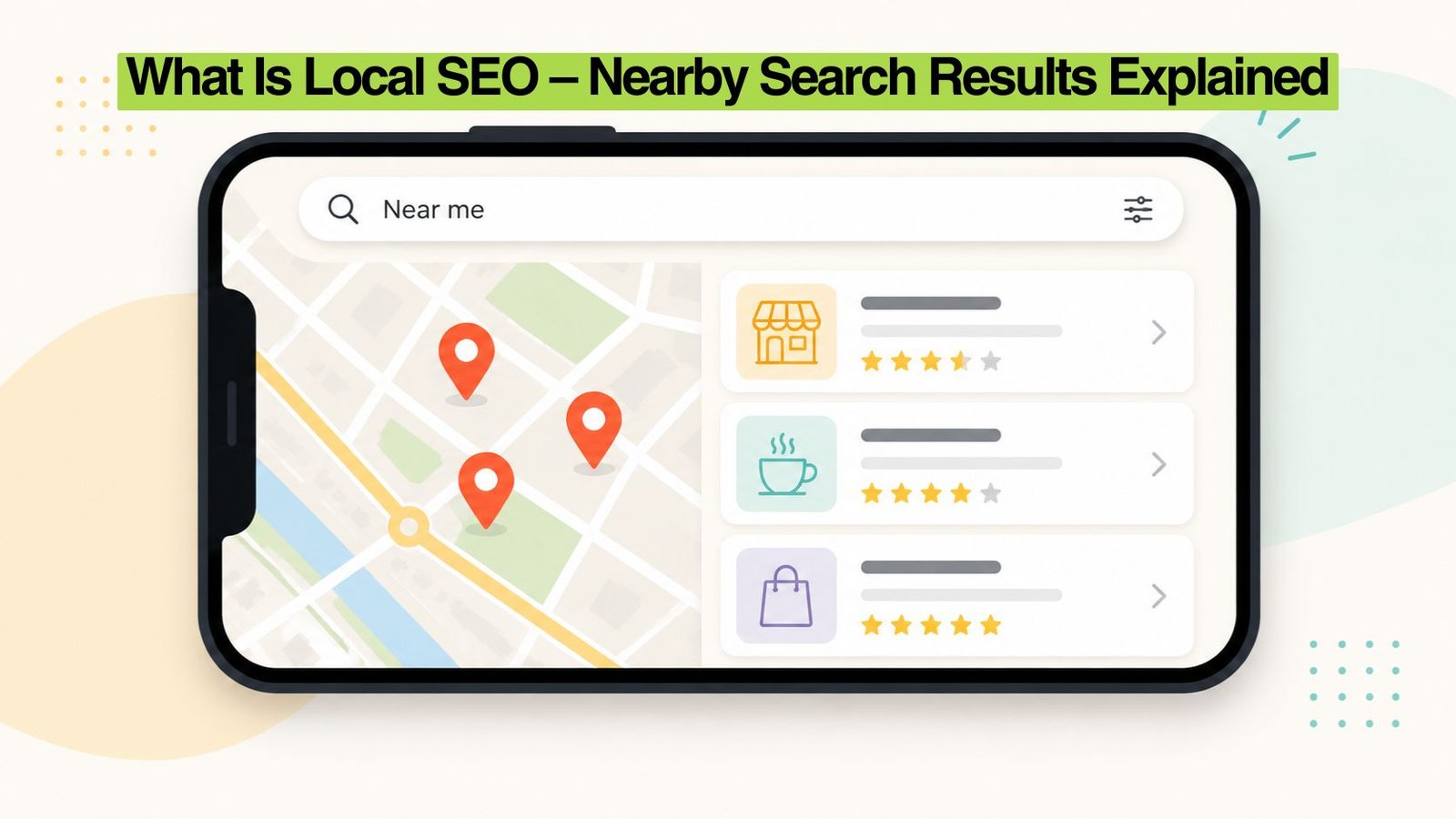
Think of a plumber, a dentist, a HVAC repair company, or a law firm. Nobody searching for “emergency plumber” cares about a plumber three states away. They want someone who can show up at their door today. That’s the exact behavior local SEO is designed to capture.
Key Local SEO Ranking Factors
Local SEO relies on a distinct set of ranking signals that national organic strategies don’t typically prioritize:
- Google Business Profile (GBP): Your GBP listing is often the very first touchpoint a searcher has with your business — before they ever visit your website. A complete, accurate, well-managed profile is foundational.
- Google Maps Pack / local 3-pack: The three business listings that appear above traditional organic results for “near me” searches. Ranking here is often more valuable than ranking #1 organically, because it’s the first thing users see and click.
- NAP consistency: Your business Name, Address, and Phone number need to match exactly across your website, GBP, and every directory listing. Inconsistencies quietly erode trust signals with Google.
- Citations: Listings of your business across local directories, industry sites, and data aggregators. Citations reinforce that your business is real, active, and locatable.
- Proximity ranking signal: Google factors in how close a searcher physically is to your business location when deciding what to show in local results.
- Online reviews: Review volume, recency, and star rating directly influence both rankings and click-through rate in local results.
- Local landing pages and geo-modified keywords: Content built around specific service areas — “roof repair in [city]” rather than just “roof repair” — helps you rank for the exact phrasing local searchers use.
Who Local SEO Is Best For
Local SEO is the right foundation for:
- Single-location small businesses with a physical storefront or service area
- Service-area businesses that travel to customers (plumbers, electricians, roofers, HVAC technicians)
- Professional practices like medical offices, dental clinics, and law firms
- Restaurants, retail stores, and salons
- Any business where the buyer journey ends with “I need someone nearby, right now”
The common thread across all of these examples is urgency and proximity. A searcher isn’t comparing options across the country — they’re deciding among the handful of businesses that can realistically serve them today. That’s a fundamentally different buyer journey than someone researching a national purchase, and it’s why local SEO has its own dedicated playbook rather than simply being a smaller version of national SEO.
What Is National SEO?
National SEO takes the opposite approach. Instead of narrowing focus to a specific city or region, it’s built to compete for visibility across an entire country — or globally — for keywords that have no geographic qualifier at all.
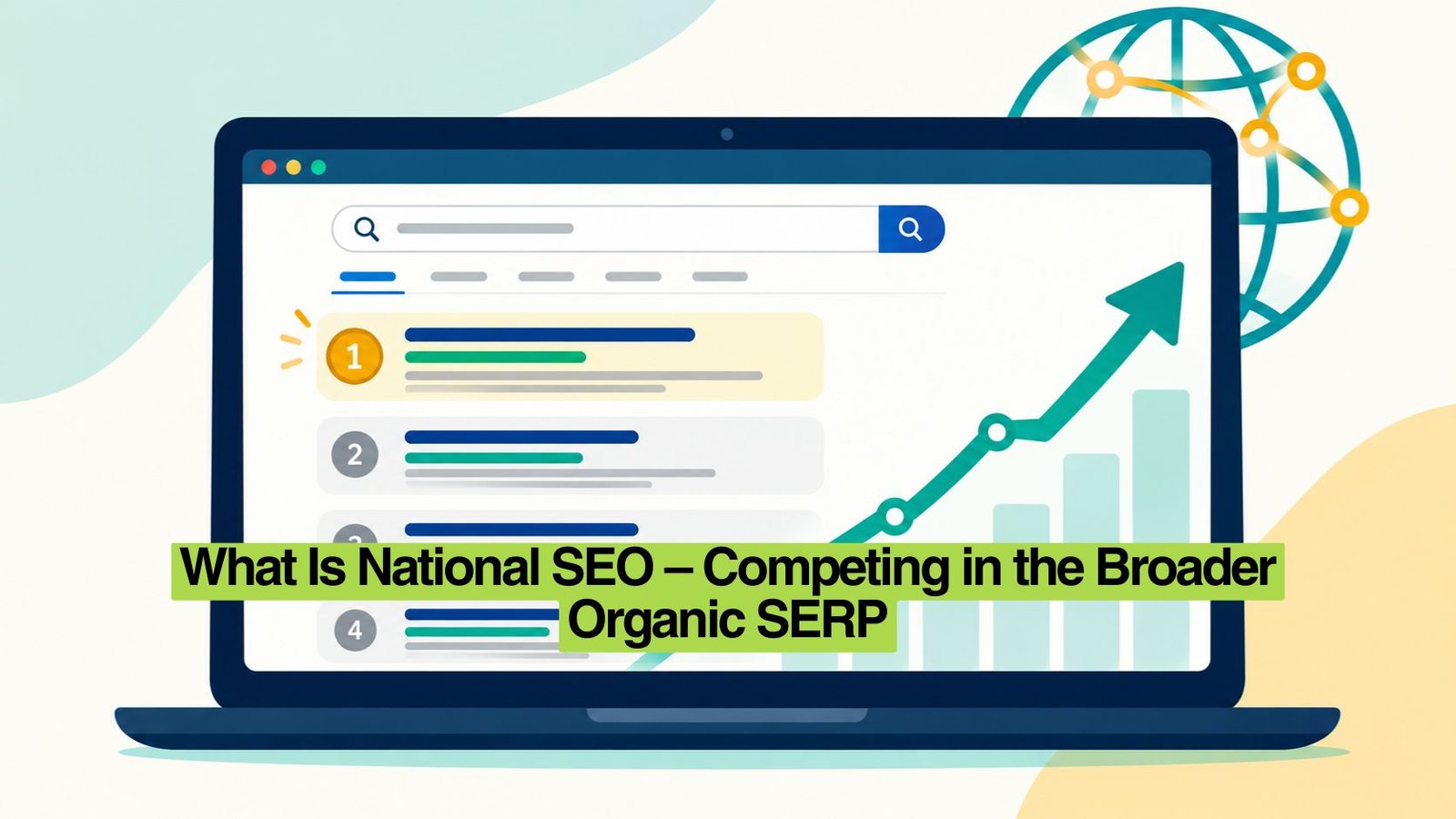
If local SEO answers “who’s near me,” national SEO answers “who’s the best, period.” That’s a fundamentally different, and typically much harder, competition to win.
Key National SEO Ranking Factors
National organic strategies lean on a different weighting of ranking signals:
- Domain authority: A cumulative trust score built through consistent content, technical health, and a strong backlink profile. Competing nationally almost always requires stronger domain authority than competing locally.
- Backlink profile: National rankings depend heavily on earning links from authoritative, relevant sites across your industry — not just local directories.
- Head terms / broad keywords: National SEO targets high-volume, non-geographic search terms — “project management software” instead of “project management software in Austin.”
- Content marketing and topical authority: Because you’re not narrowing your audience by geography, you have to earn relevance through content depth — comprehensive resources, guides, and tools that establish your site as the definitive answer on a topic.
- Site architecture: National sites typically need more sophisticated internal linking and content hierarchies to organize a much larger keyword footprint.
- Competitive keyword difficulty: You’re no longer competing with the ten other businesses in your zip code — you’re competing with every business in your industry nationwide, which usually means significantly higher keyword difficulty.
Who National SEO Is Best For
National SEO is the better fit for:
- E-commerce brands shipping products anywhere
- SaaS companies and software platforms with no physical service radius
- Businesses without a storefront or defined service area
- Enterprise SEO programs for companies competing on an industry-wide or global scale
- Content publishers, media sites, and info-product businesses
Local SEO vs. National SEO: Key Differences
Both strategies fall under the umbrella of organic SEO — earning visibility in search results without paying for placement — but they diverge sharply in execution. Here’s where the real differences show up.
Target Audience & Search Radius
Local SEO narrows its target audience to people within a specific geographic area. National SEO widens that audience to anyone, anywhere, searching for a given product or service — geography simply isn’t a filter.
Keyword Strategy (Geo-Modified vs. Broad/Head Terms)
Local keyword research centers on geo-modified phrases — “roofer in Angleton,” “personal injury lawyer near me.” National keyword research targets broad head terms with high search volume and no location qualifier — “personal injury lawyer,” “roofing contractor.”
This distinction matters more than it might seem. Local vs national keyword research isn’t just about adding a city name — it changes search volume expectations, competition level, and even the type of content that ranks.
Competition Level & Cost
This is where the practical stakes become clear. A local plumber only needs to outrank the handful of other plumbers operating in their service area. A national software company needs to outrank every competitor in its category, everywhere its target customers might search.
Fewer competitors generally means:
- Lower conversion rate optimization (CRO) and content investment required to compete
- Faster movement in rankings
- A smaller, more achievable budget for meaningful results
More competitors — the national scenario — generally means higher costs, longer timelines, and a bigger investment in content and links to break through.
Content & Landing Page Structure (City Pages vs. Topic Pages)
Local SEO content is built around place: dedicated local landing pages for each city or service area you cover, each optimized for its own geo-modified keywords.
National SEO content is built around topic: comprehensive resource hubs, guides, and pillar pages designed to establish topical authority across an entire subject area, regardless of where the reader is searching from.
Link Building Approach
Local link building focuses on local directories, chamber of commerce listings, local news mentions, and community partnerships. National link building focuses on earning coverage and citations from authoritative industry publications, national media, and high-domain-authority sites relevant to the broader topic.
Ranking Signals (Local Pack/Maps vs. Traditional Organic SERP)
Local SEO success is measured heavily by visibility in the Google Maps Pack / local 3-pack — a completely separate ranking system from the traditional ten blue links. National SEO success is measured almost entirely by position in the standard organic SERP, since there’s no map-based equivalent for non-local searches.
Timeline to Results
Because local competition is narrower, local SEO tends to show measurable movement faster — often within a few months. National SEO, competing against a much larger field with stronger domain authority requirements, typically takes longer to gain meaningful traction — frequently six months to a year or more before ranking for genuinely competitive head terms.
Comparison at a Glance
The table below distills the key distinctions side by side, so you can see exactly where local and national SEO diverge — and quickly gauge which column looks more like your business.
| Factor | Local SEO | National SEO |
|---|---|---|
| Target Audience | Customers within a defined geographic area | Customers anywhere in the country/market |
| Keyword Focus | Geo-modified keywords, “near me” searches | Broad head terms, non-geographic keywords |
| Primary Ranking Signals | GBP, citations, NAP consistency, proximity, reviews | Domain authority, backlink profile, topical authority |
| Content Structure | City/service-area landing pages | Topic hubs, pillar pages, resource guides |
| Where You Compete | Local Maps Pack + local organic results | Traditional organic SERP |
| Competition Level | Lower — local businesses only | Higher — industry-wide or national |
| Typical Cost | More affordable | Higher investment required |
| Typical Timeline | Faster — often 1–6 months | Slower — often 6–12+ months |
| Best Fit | Single-location, service-area businesses | E-commerce, SaaS, enterprise, national brands |
How Local and National SEO Work Together
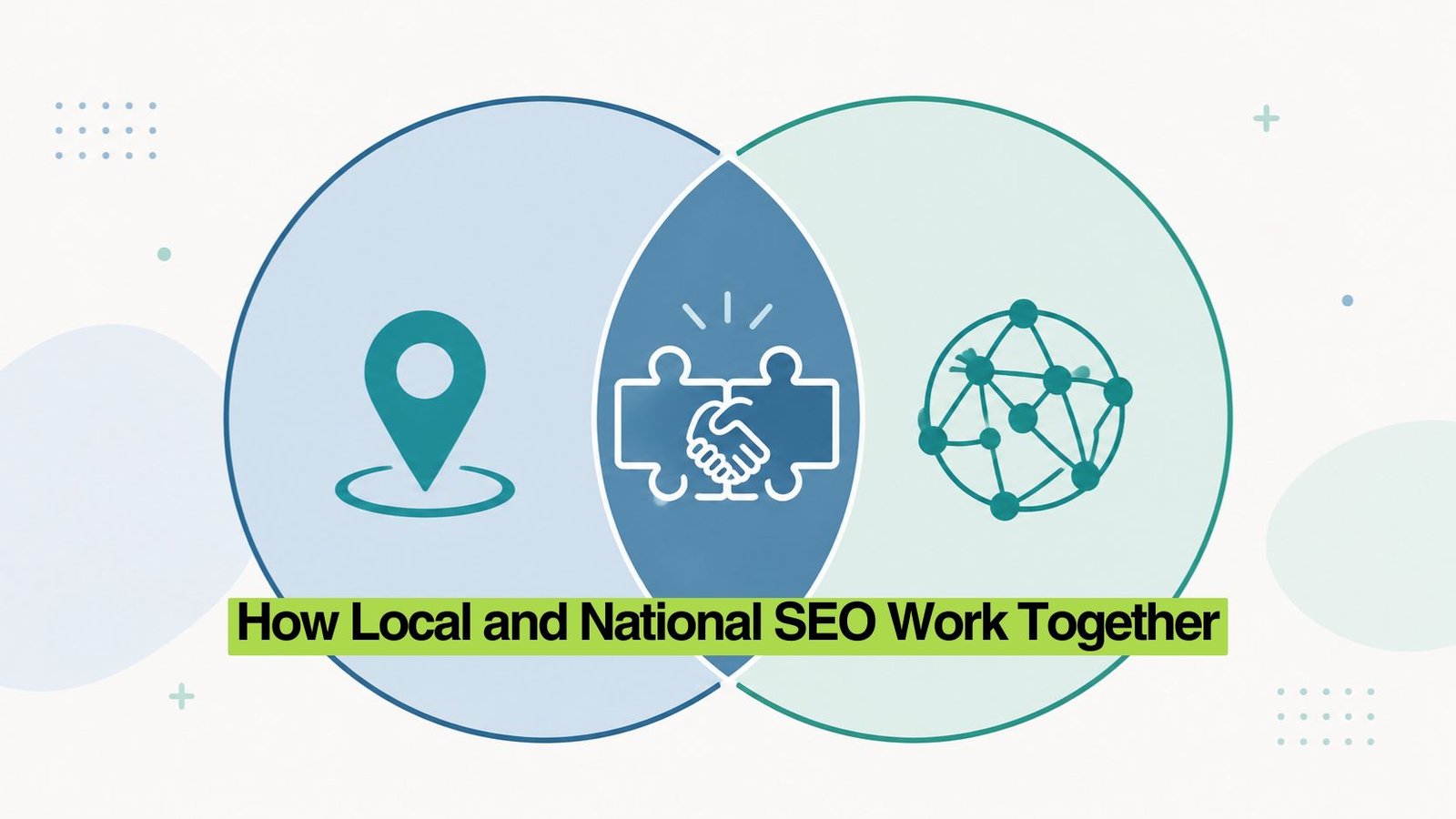
Here’s an important reframe: local SEO and national SEO aren’t competing philosophies. They’re tools — and many businesses need both, at different points in their growth or across different parts of the same website.
Why They’re Not Mutually Exclusive
A strong backlink profile and solid technical SEO foundation — clean site architecture, healthy Core Web Vitals, proper schema markup — benefit local and national rankings simultaneously. Domain authority built through national-level content marketing can lift the credibility of your local pages too. And a well-optimized GBP profile can support a national brand’s individual store locations without undermining its broader organic footprint.
In short: strong on-page SEO and technical SEO are the shared infrastructure underneath both strategies. Neither one exists in a vacuum.
It also helps to think about measurement. Whether you’re running a local campaign, a national one, or both, the same analytics foundation applies: GA4 (Google Analytics 4) and Google Search Console track how visitors find and move through your site, which pages drive organic traffic, and where searchers drop off before converting. The dashboards and specific goals you track will differ — local campaigns often prioritize phone calls, direction requests, and form fills tied to a specific location, while national campaigns lean more heavily on assisted conversions across a longer research cycle — but the underlying measurement discipline is identical. If you’re only tracking rankings and ignoring what happens after the click, you’re missing the metric that actually matters: conversions.
Example: A Multi-Location or Regional Business Using Both
Consider a multi-location business — a regional HVAC company with five branches across a metro area, expanding into neighboring counties. This is a textbook case for a hybrid SEO strategy:
- Each branch gets a dedicated local landing page, optimized with geo-modified keywords, its own GBP listing, and location-specific citations — pure local SEO execution.
- Meanwhile, the company builds broader content — buying guides, maintenance resource hubs, industry comparisons — designed to build topical authority and compete for higher-volume, non-geographic terms across the region. That’s the national/broad-strategy layer, scaled to a regional footprint.
- The result: the company shows up in the local 3-pack for “HVAC repair near me” in every city it serves, and ranks organically for broader informational searches that bring in leads before they’ve even picked a specific branch.
Franchise SEO follows the same logic at a larger scale — a national brand with local franchise locations typically needs a corporate-level national content strategy layered on top of dozens (or hundreds) of individually optimized local profiles.
How to Decide Which Strategy Your Business Needs
If you’re still asking yourself “which SEO strategy is right for my business,” the answer usually comes down to one question: how does your customer’s buyer journey actually start?
Signs You Need Local SEO
- You operate from one or a few physical locations
- Customers need to visit you, or you travel to them, within a limited radius
- Your ideal customer searches “near me” or includes a city/neighborhood name in their query
- You’re a service-area business — plumber, electrician, roofer, HVAC technician, contractor
- Your competition is realistically limited to businesses in your immediate area
- You want faster, more budget-efficient results to start
Signs You Need National SEO
- Your product or service can be delivered anywhere — physically shipped or fully digital
- You’re an e-commerce brand, SaaS company, or online-only service provider
- Your customers search using broad, non-geographic terms
- You’re building a national or global brand and can invest in a longer-term content and link-building strategy
- Your competitors are national or global companies, not local businesses
Signs You Need a Hybrid Strategy
- You’re a regional business or multi-location business serving more than one city or metro area
- You’re a franchise with both corporate brand visibility goals and individual location performance needs
- You started local and are actively expanding into new markets
- You want to capture both “near me” searches today and broader industry-wide visibility for long-term growth
Frequently Asked Questions
Is local SEO cheaper than national SEO?
Can a local business benefit from national SEO?
Does Google Business Profile matter for national SEO?
How long does local SEO take vs. national SEO?
Can I switch from local to national SEO later as my business grows?
Key Takeaways (Summary)
- Local SEO and national SEO aren’t competing strategies — they’re built for different search behaviors and different business models.
- Local SEO wins on speed, cost-efficiency, and relevance for businesses tied to a physical service area.
- National SEO wins on scale, but demands more content, more backlinks, and more patience.
- Multi-location, regional, and franchise businesses often need both, working in tandem.
- The right starting point isn’t about company size — it’s about how your actual customers search for what you offer.
Not Sure Which Strategy Fits Your Business?
Choosing between local, national, or a hybrid SEO strategy shouldn’t be a guessing game. The right approach depends on your specific market, your competition, and where your customers are actually searching from — and getting that starting point wrong can cost months of wasted effort.
At B2B Allies, we help businesses across Houston, the Texas Gulf Coast, and beyond figure out exactly where their search visibility gaps are — and build a strategy around real data, not assumptions.
Request a free SEO audit and we’ll show you precisely where your business stands, and which strategy will actually move the needle.