Your last three projects came from referrals. Your website looks incredible. And you still can’t say with any confidence where your next inquiry is coming from.
That’s the problem SEO solves — not because organic search is trendy, but because referrals are unpredictable and your competitors are already ranking for the searches your future clients are typing right now. This guide walks through what SEO for architects actually involves, why it works differently than SEO for other service businesses, and what to prioritize first.
What SEO for Architects Actually Means
Search Engine Optimization is the practice of structuring and writing a website so it shows up when people search for what you offer. For architecture firms, that means appearing when someone searches “residential architect for a home addition,” “commercial architect near me,” or “sustainable architecture firm [city].”
The mechanics are the same ones every industry deals with: on-page SEO, technical SEO, local SEO, content, and backlinks. What’s different is the buyer.
Architecture clients aren’t making an impulse purchase. They’re planning a project that will take months, sometimes years, and cost a meaningful chunk of their budget. They research carefully. They compare portfolios. They read project descriptions looking for evidence that you’ve handled something like their project before. By the time they fill out a contact form, they’ve usually already decided you’re a serious contender — the SEO work happened long before that click.
This matters because it changes what “ranking” is worth. A single qualified inquiry from a homeowner planning a custom home design, or a developer sourcing a design-build firm for a multifamily project, can be worth more than a hundred visits to a blog that never converts. Architecture SEO isn’t a traffic game. It’s a qualified-lead game.
Why Architecture Clients Search Differently
Most service businesses compete on speed and convenience. Architecture firms compete on trust and fit. A prospective client searching for an architect has usually already narrowed their options mentally — style, budget range, building type — before they ever pick up the phone. Your website’s job in the search results isn’t to convince a stranger to consider architecture. It’s to convince someone who’s already decided to hire an architect that you’re the right one.
That’s why generic visibility isn’t the goal. Showing up for “architect” as a bare term does almost nothing. Showing up for “historic renovation architect” when someone is trying to restore a 1920s property does everything.
Informational vs. Transactional Keywords
Architecture keywords split into two rough camps, and a strong strategy targets both.
Transactional keywords carry hiring intent: “commercial architect near me,” “passive house architect [city],” “residential architect for extensions.” These are the searches closest to a signed contract.
Informational keywords carry research intent: “how much does an architect cost,” “do I need an architect for a renovation,” “what’s the difference between an architect and a design-build firm.” These searches happen earlier, but they’re where trust gets built — and where content marketing does its heaviest lifting.
Keyword Research for Architecture Firms
Keyword research for an architecture firm isn’t about chasing the highest search volume. It’s about finding the specific terms that match what you actually design, at a level of detail generic architecture directories never bother with.
Service-based keywords describe the type of work: residential architect, commercial architect, renovation architect, home addition design. These should map directly to service pages on your site, not just get mentioned in passing on a single “services” page.
Style and specialty keywords describe how you design: sustainable architecture, Passivhaus (passive house) design, historic renovation, custom home design, LEED-focused projects. If a specialty is genuinely part of your practice, it deserves its own page — not a paragraph buried in your “about” section.
Location-based keywords pair your services with geography: “commercial architect in [city],” “architecture firm serving [region].” Even firms that work regionally or nationally should have a clear primary market reflected in their site content.
Long-tail keywords combine two or three of the above: “Passivhaus architect for multifamily housing in [city].” These get less search volume individually, but they convert at a much higher rate because the person searching already knows precisely what they want.
Where do you find these terms? Google Search Console shows you what people are already searching to find your site — often the fastest source of ideas, since it’s real behavior, not a guess. Google Keyword Planner gives you a broader starting list. Tools like Ahrefs, SEMrush, or Moz go further if your firm has access to them, but they’re optional — a firm with a clear sense of its own services and specialties can build a strong keyword list without paid tools.
[Internal link: /seo/]
On-Page SEO: Making a Portfolio-Led Site Actually Rankable
Here’s the tension nobody in this niche wants to name directly: architects build sites to look like portfolios. Search engines need sites that read like text. Those two goals pull in opposite directions, and most firm websites resolve the conflict by ignoring the second one entirely.
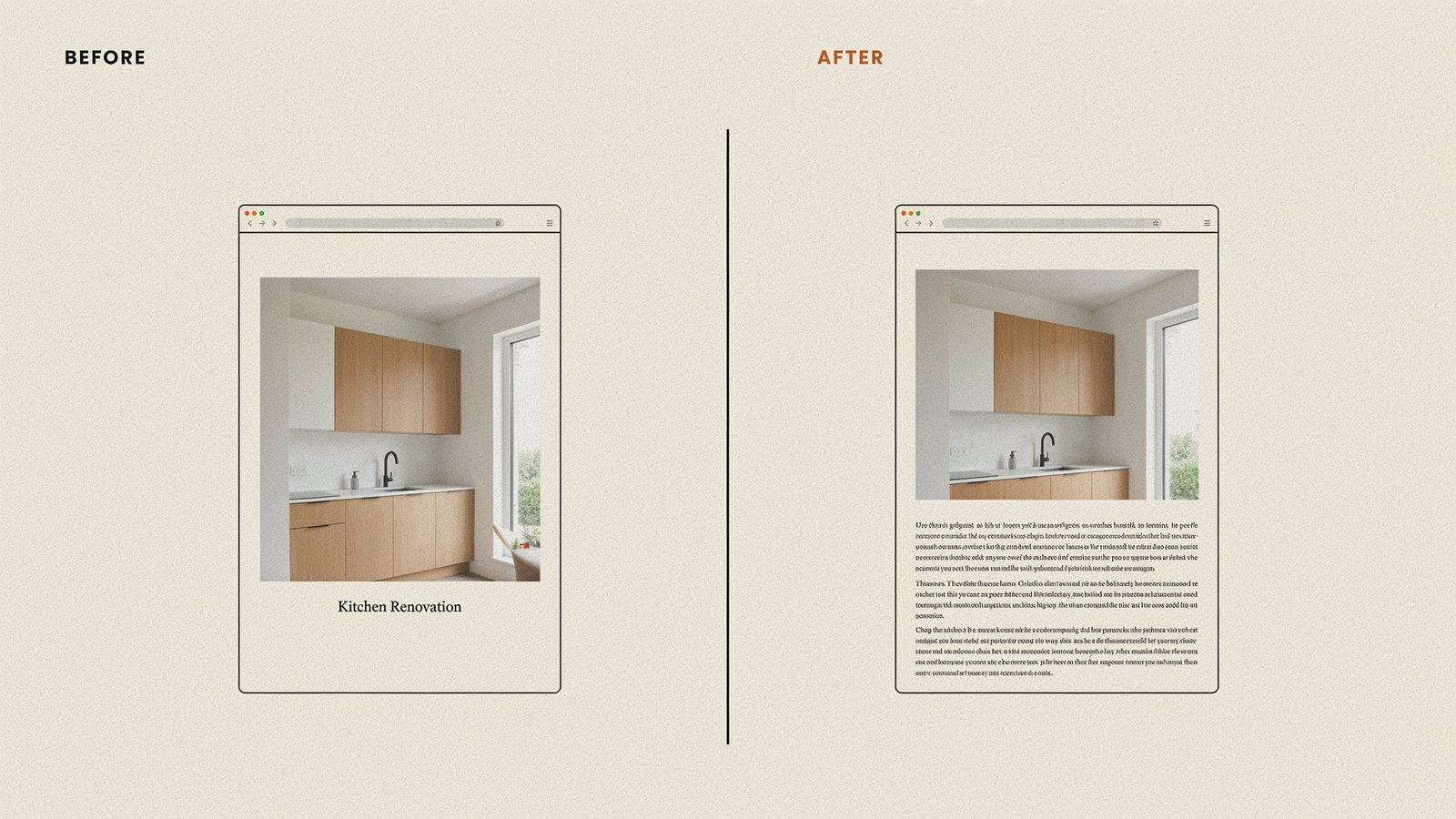
A project showcase built from ten stunning images and a two-word caption is a beautiful presentation and an SEO dead end. Google has nothing to index. There’s no keyword-relevant content signaling what the project actually is, where it’s located, or what problem it solved.
The fix isn’t to strip the visual identity out of your site. It’s to give every project page enough real content to be found, while keeping the visual presentation exactly as strong as it is now.
Writing Project Descriptions That Rank
Every project page should include, in actual sentences, the building type (single-family residence, multifamily, mixed-use, institutional), the location, the scope of work, and the design approach. If a project involved sustainable materials, a historic renovation constraint, or a Passivhaus-certified build, say so plainly — that’s exactly the language a prospective client with the same project type is searching for.
This doesn’t mean writing an essay under every image. Two or three well-built paragraphs per project, written the way you’d describe the job to a colleague, does more for your search visibility than any amount of image styling.
Image SEO for Architecture Photography
Architecture sites live and die by photography, which makes image SEO more important here than in almost any other industry. Every image needs descriptive alt text — not “IMG_4021.jpg,” but a real description of what’s shown: “modern kitchen renovation with custom cabinetry, [city].” Alt text serves two purposes at once: it helps search engines understand image content, and it makes your site accessible to users relying on screen readers.
File names, compression, and image dimensions matter too, and they lead straight into the technical SEO section below — because on a photography-heavy site, technical performance and on-page content are the same problem wearing two names.
Title Tags and Meta Descriptions
Every service and project page needs a title tag and meta description written for a human, not stuffed with keywords. A title tag like “Residential Architect in [City] | Custom Home Design” tells both Google and the searcher exactly what the page offers. A meta description that names the specific service and invites a click will outperform a generic one every time, even if it doesn’t move rankings directly — it moves the click-through rate on the search engine results page (SERP), which is the part of SEO people forget matters just as much as the ranking itself.
[Internal link: /web-development/]
Local SEO for Architecture Firms
Most architecture clients want someone local — someone who understands local building codes, local materials, local permitting processes. That makes local SEO one of the most valuable pieces of this entire strategy.
Google Business Profile
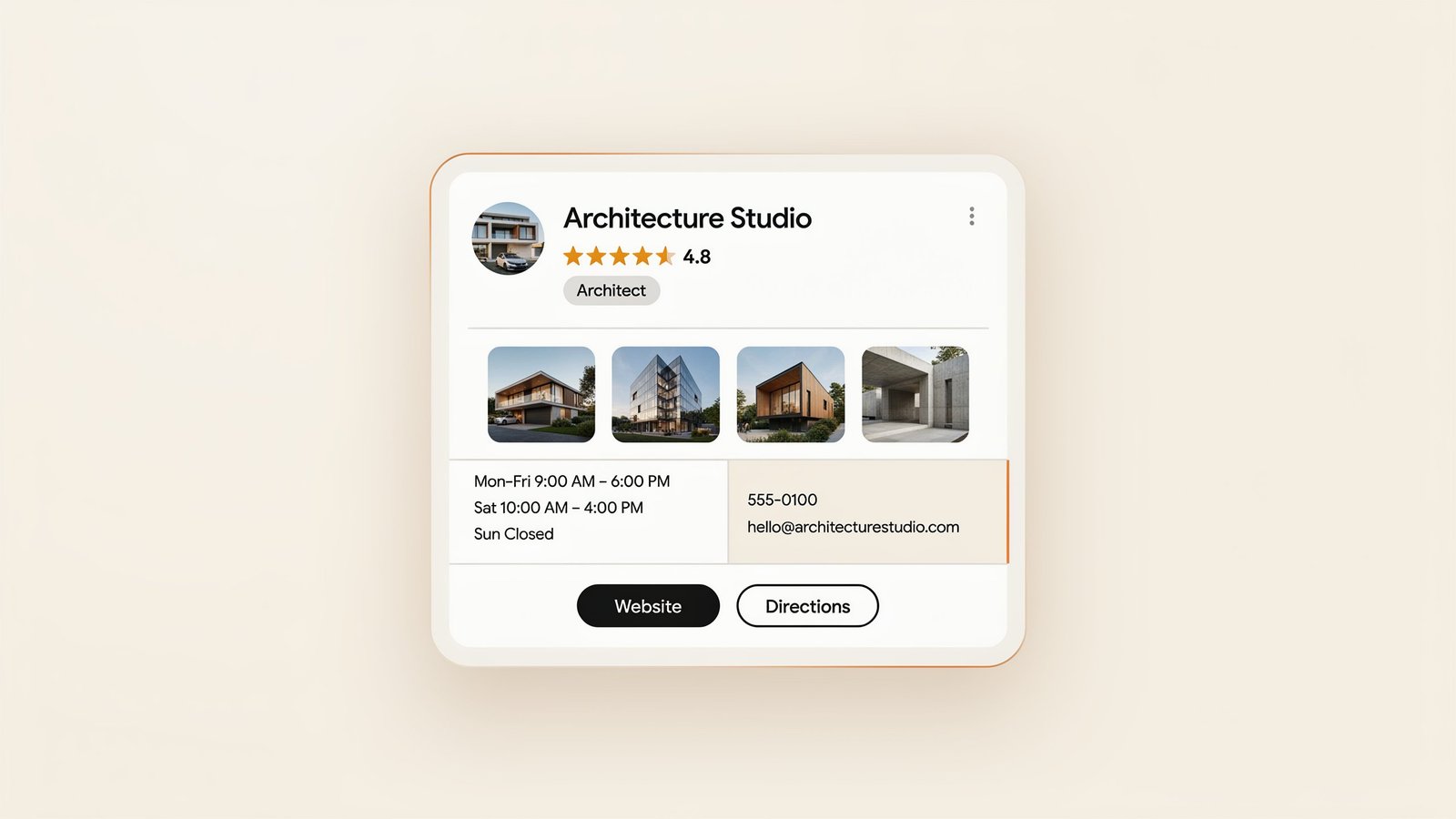
Your Google Business Profile is the single highest-impact local SEO asset you have, and it’s free. Claim it, fill in every field completely, choose the most accurate service categories, and keep it updated with real photos of finished projects. A profile that looks abandoned signals exactly that to both Google and the person viewing it.
NAP Consistency
NAP stands for Name, Address, Phone number, and it needs to match exactly across your website, your Google Business Profile, and every directory or citation where your firm appears. A firm listed as “Smith Architecture” in one place and “Smith Architecture, LLC” in another creates confusion that search engines read as a trust problem, not a typo.
Building Local Relevance Beyond Google
Local relevance isn’t only about your profile. Membership in your local American Institute of Architects (AIA) chapter, sponsorships of local design or building events, coverage in local press, and citations from architecture and construction directories all reinforce that your firm is a real, established presence in your market — not just a website with a service area listed on it.
[Internal link: /local-seo/]
Content Marketing: What to Write Beyond the Portfolio
A portfolio proves you can design. It doesn’t answer the questions a prospective client is asking before they’ve even found your site. Content marketing fills that gap — and it’s where most architecture firms leave the most opportunity on the table.
Write for the Client, Not the Peer Review
There’s a real difference between content written to impress other architects and content written to answer a homeowner’s or developer’s actual pre-purchase questions. “How much does hiring an architect cost,” “do I need an architect for a home addition,” “how long does the design process take” — these are searches with real volume and real buying intent behind them, and almost no architecture firm answers them directly on their own site.
Case Studies Are Not Portfolio Pages
This distinction gets blurred constantly, and it’s worth being precise about. A portfolio page shows the finished work. A case study tells the story: the problem the client came in with, the design decisions made along the way, the constraints (a historic renovation restriction, a tight urban lot, a strict LEED requirement), and the outcome. Case studies give search engines far more to work with, they demonstrate expertise in a way a photo gallery can’t, and they’re genuinely more persuasive to a reader trying to decide if you understand their specific situation.
FAQs Capture the Searches You’re Currently Missing
A well-built FAQ section, on either a dedicated page or woven into service pages, is one of the most efficient ways to capture long-tail keywords without writing a new blog post for every variation of a question. “Do I need an architect to submit an RFP for a commercial project” and “what’s the difference between an architect and a design-build firm” are both real questions worth a direct, honest answer.
[Internal link: /graphic-design/]
Technical SEO: The Part Image-Heavy Sites Get Wrong
Technical SEO covers the parts of your site search engines evaluate that have nothing to do with the words on the page — and for architecture firms, this is where beautiful sites quietly sabotage themselves.

Page Speed and Core Web Vitals
Architecture sites run heavier than almost any other business site: high-resolution architectural rendering files, embedded video walkthroughs, downloadable PDF portfolios. Every one of those assets, unoptimized, slows the site down. Google measures this directly through Core Web Vitals — a set of metrics covering how fast a page loads, how quickly it becomes interactive, and how stable the layout is while it loads. A slow, image-bloated project page doesn’t just frustrate visitors; it actively suppresses your rankings.
The fix is usually straightforward: compress images before upload, use modern file formats, and avoid loading every project’s full-resolution gallery on a single page. None of this requires sacrificing visual quality — it requires doing the compression work that most portfolio-first sites skip.
Mobile-First Indexing
Google indexes and ranks based primarily on the mobile version of your site, not the desktop version — a policy known as mobile-first indexing. If your portfolio galleries, navigation, or contact forms behave worse on a phone than on a desktop monitor, that’s the version Google is actually judging you on.
Site Architecture
Site architecture — how your pages are organized and linked to each other — determines how easily both users and search engines can find your service pages, location pages, and project pages. A site with a flat structure and clear internal linking between related project types performs better than one where every project page is an island with no path back to a relevant service page.
Link Building and Authority for Architecture Firms
Backlinks — links from other websites pointing to yours — remain one of the strongest signals search engines use to judge a site’s domain authority and trustworthiness. For architecture firms, the best link opportunities are usually industry-specific rather than generic.
AIA chapter directories, architecture and design publications, awards programs, and guest contributions to industry sites all build the kind of backlink profile that reads as genuinely authoritative rather than manufactured. A single link from a respected design publication, earned through real project coverage, does more for your search visibility than dozens of low-quality directory listings.
This is also where E-E-A-T comes into play — Google’s framework for evaluating experience, expertise, authoritativeness, and trustworthiness. For architecture firms, that means the content on your site should visibly reflect real project experience, and the sites linking to you should reflect real industry standing. Structured data, specifically schema markup, can reinforce this too: LocalBusiness or ProfessionalService schema helps search engines understand exactly what kind of business you are, where you operate, and how to display that information accurately in the search results.
How to Measure Whether Your SEO Is Working
Traffic is the easiest metric to track and the least useful one on its own. A blog post that gets a thousand visits and zero inquiries hasn’t done its job.
The metrics that matter for an architecture firm are qualified inquiries, RFP requests, and consultation bookings — tracked back to organic search as the source. This is conversion rate optimization applied to a service business: the goal isn’t just getting people to the site, it’s getting the right people to take the next step once they arrive.
Set a realistic timeline going in. SEO for a high-consideration service like architecture moves slower than it does for e-commerce or fast-decision purchases — search volumes are lower, sales cycles are longer, and local markets are smaller. Meaningful movement typically takes months, not weeks. That’s not a weakness in the strategy. It’s the nature of a business where the average client hires an architect once every several years, if that.
DIY SEO vs. Hiring an Agency
Some of this is genuinely doable in-house. A small firm with someone willing to own the Google Business Profile, write honest project descriptions, and keep NAP details consistent across the web can make real progress without outside help.
Where it usually breaks down is consistency. Technical SEO, ongoing keyword research, content production, and link building all require sustained attention — and most firm owners and project architects are, correctly, spending their billable hours on projects, not on search engine results pages. The firms that struggle most with SEO aren’t the ones who don’t understand it. They’re the ones who understood it for three months and then got busy.
If that sounds familiar, an SEO audit is the right next step — not a full engagement, just a clear look at what’s actually holding your site back before you decide how much of this to take on yourself.
[Internal link: /contact-us/]
Frequently Asked Questions
How long does SEO take to work for an architecture firm?
Do architects really need SEO if most work comes from referrals?
What's the difference between SEO and paid ads for architects?
Do I need a blog if I'm an architect?
Is local SEO more important than broader SEO for architects?
The Next Step
Your portfolio already proves you can design. The work now is making sure the people who need exactly what you design can actually find you before they find someone else.
Start with the parts of this guide that are genuinely broken on your current site — a stale Google Business Profile, project pages with no real content, inconsistent NAP details across directories. Fix those first. Then build outward into content, technical performance, and link building as capacity allows.
If you’d rather have someone look at your site with an outside eye and tell you exactly where the gaps are, that’s what an SEO audit is for.