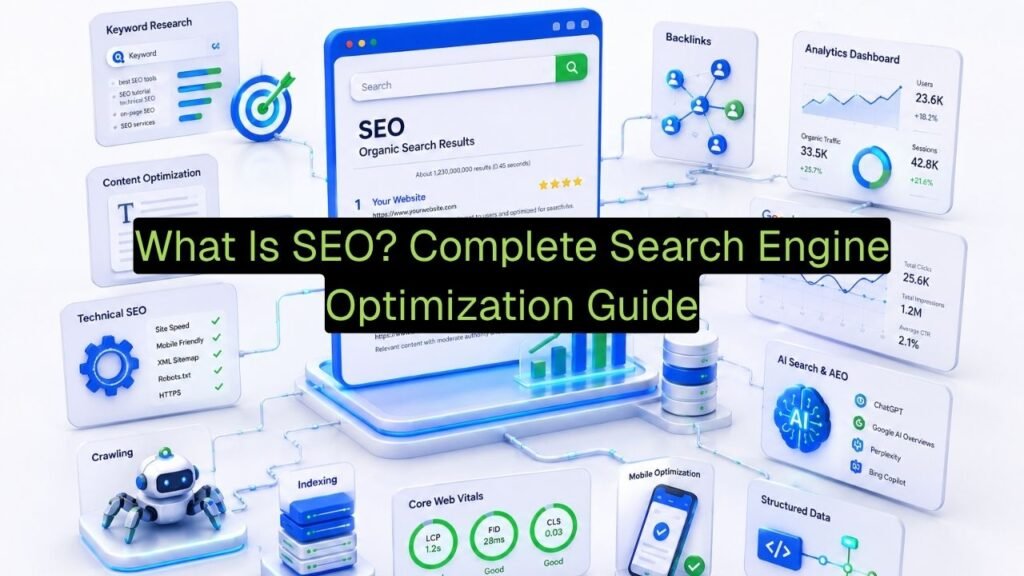
SEO is the practice of improving a website so it ranks higher in unpaid search results — think Google or Bing — and earns more organic traffic without paying for ads. It works by aligning what a site offers with what a search engine’s algorithm rewards: relevant content, a technically sound site, and enough outside trust signals to convince the engine your page deserves a top spot.
That’s the textbook version. The working version is messier, slower, and more interesting — and it’s what the rest of this guide covers.
What Is SEO? (The Direct Answer)
Search engine optimization is the process of improving a website’s visibility in a search engine’s unpaid results by optimizing its content, technical structure, and off-site authority. The goal is to rank for the terms a target audience actually searches, so the site earns consistent organic traffic instead of relying entirely on paid advertising.
Everything below is the “how” behind that one paragraph.
How Search Engines Actually Work
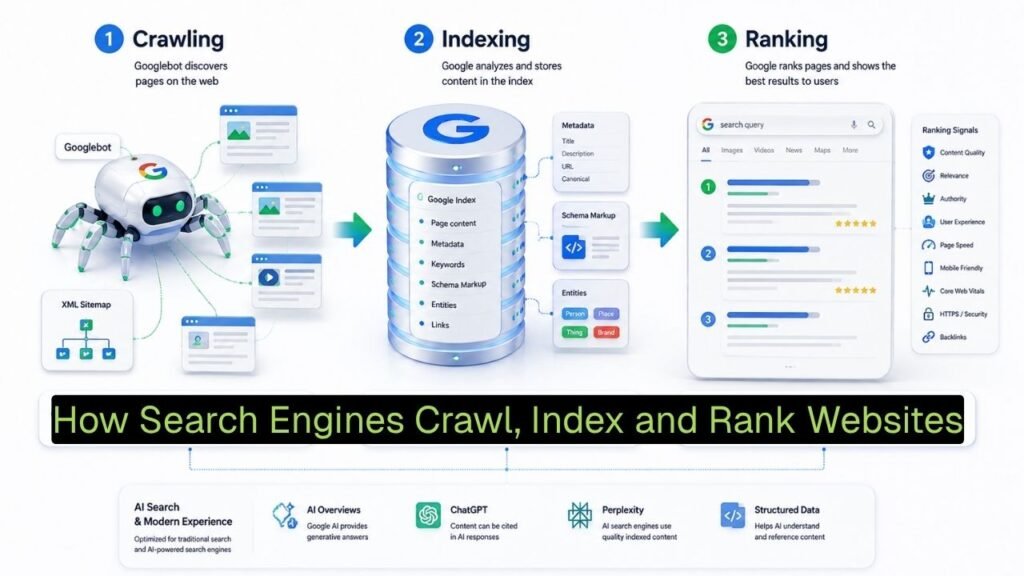
Before any of the tactics matter, it helps to understand what a search engine is actually doing behind the scenes. Google and Bing run on the same three-stage process, even though the specifics of their algorithms differ.
Crawling — How Google Finds Your Pages
A search engine sends automated programs, often called crawlers or bots, out across the web to discover pages. They follow links — from one page to another, from one site to another — building a map of what exists. If a page has no links pointing to it and isn’t submitted anywhere, a crawler may never find it at all.
Indexing — How Google Stores and Understands Content
Once a crawler finds a page, the search engine reads it and decides whether to store it in its index — essentially a massive, searchable database of web content. A page can be crawled and still not indexed, usually because it’s low-quality, duplicate, or blocked by a robots.txt file or a noindex tag. Indexing is where a canonical tag also matters: it tells the engine which version of a page is the “real” one when duplicates exist.
Ranking — How Google Decides What to Show First
When someone runs a search, the engine scans its index and ranks the most relevant, useful pages for that specific query, arranging them on the search engine results page — the SERP — in the order it believes best answers the query. This is where ranking factors come in — hundreds of signals, from keyword relevance to page speed to backlink quality, that the algorithm weighs to decide what belongs on page one. No single factor guarantees a top position; it’s the combination that matters, and Google adjusts the weighting constantly.
The Three Pillars of SEO
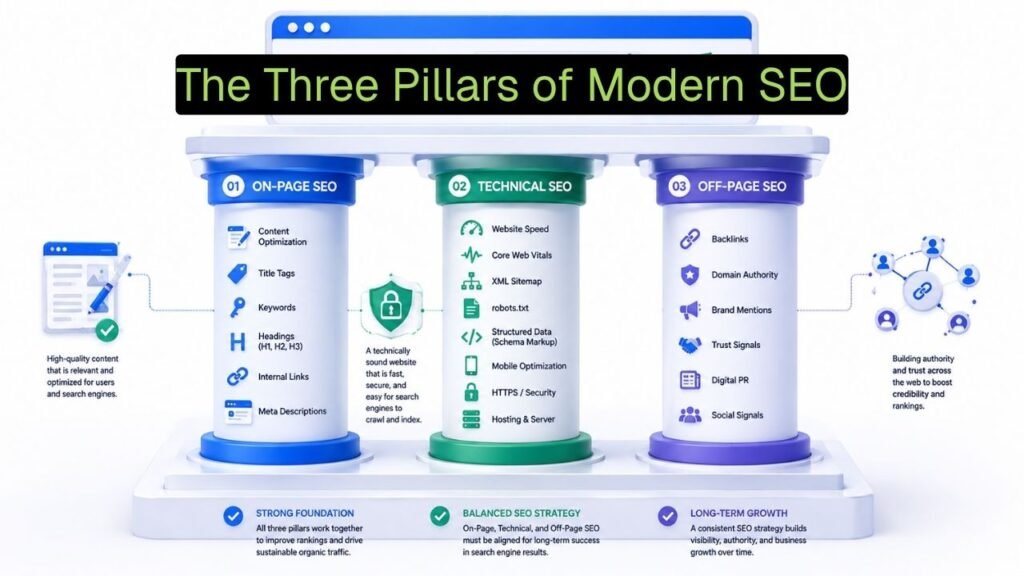
Nearly everything in SEO falls into one of three buckets. A site that’s strong in only one of them tends to plateau — real results come from balancing all three.
On-Page SEO
On-page SEO covers everything you control directly on a given page: the title tag, the meta description, header structure, keyword placement, alt text on images, and internal links to other pages on the site. Done well, on-page SEO makes a page’s topic unmistakable to both a reader skimming it and a crawler parsing it, while also supporting good UX — a page that’s easy for search engines to understand is usually easier for a real visitor to use, too. Done poorly — stuffing keywords into every sentence, writing meta descriptions no human would click — it can actively hurt rankings.
Technical SEO
Technical SEO is the infrastructure layer: making sure a site is fast, crawlable, and functioning the way both users and search engines expect. This includes Core Web Vitals (Google’s specific measurements of loading speed, interactivity, and visual stability), mobile-friendliness, a clean XML sitemap, properly configured redirects, and fixing 404 errors before they pile up and waste crawl budget. Structured data, also called schema markup, lives here too — it’s the extra code that helps a search engine understand exactly what a page is about, which can lead to star ratings or FAQ dropdowns appearing directly in search results.
Off-Page SEO (Link Building and Authority)
Off-page SEO is what happens away from your own site — mainly link building, the process of earning backlinks from other credible websites. A backlink acts as a vote of confidence: the more relevant, trustworthy sites that link to a page, the more authority a search engine tends to assign it. This authority rolls up into a site’s overall domain authority, an informal but widely used measure of how much trust a domain has accumulated over time. Off-page work also touches E-E-A-T — experience, expertise, authoritativeness, and trustworthiness — the framework Google’s quality raters use to judge whether content, and the site publishing it, deserves to rank for topics where accuracy actually matters.
The Different Types of SEO (Beyond the Three Pillars)
The three pillars describe the mechanics. These describe the context they get applied in — and this is where most explainers stop short.
Local SEO targets a specific geographic area, built around a Google Business Profile, localized keywords, and citations across local directories. It matters most for businesses with a physical location or a defined service area, where “near me” searches drive real foot traffic and phone calls. [Internal link: /local-seo/]
Ecommerce SEO applies SEO principles to product and category pages at scale — optimizing thousands of listings, managing duplicate content across product variants, and structuring a site so both shoppers and crawlers can move through a large catalog without getting lost. [Internal link: /ecommerce-seo/]
Enterprise SEO deals with the challenges that come with size: sites with tens of thousands of pages, multiple departments touching the same content, and technical issues that get expensive fast if they go unnoticed. The core tactics don’t change, but the coordination required to execute them does.
International SEO manages a site’s visibility across multiple countries or languages, typically using hreflang tags and localized content so the right regional version of a page shows up for the right audience.
Voice search optimization accounts for how people phrase spoken queries differently than typed ones — usually longer, more conversational, and closer to a full question — which shifts keyword research toward natural-language phrasing.
SEO for AI Search (Generative Engine Optimization)
This is the part most “what is SEO” guides still treat as an afterthought, and it deserves more than that.
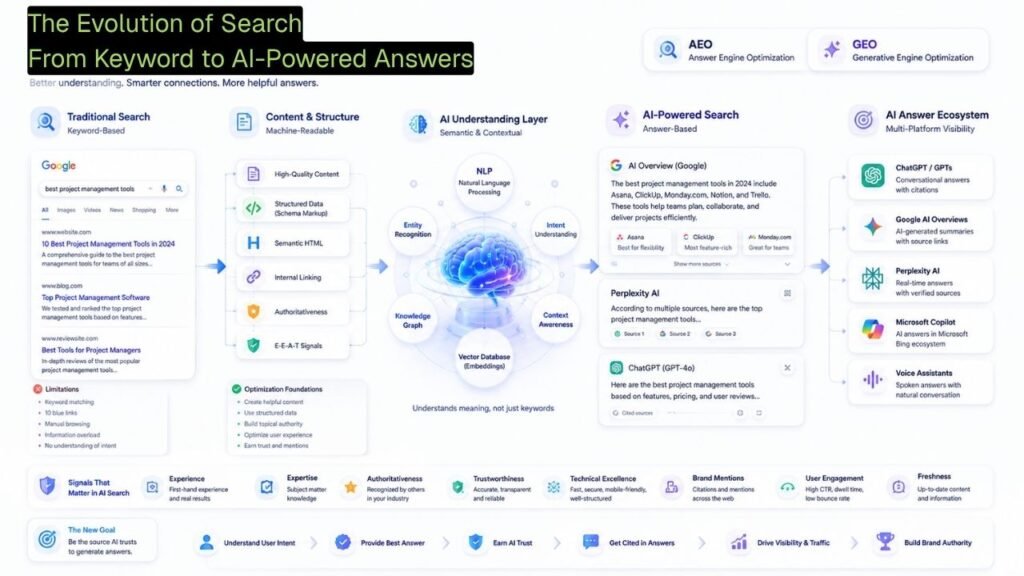
When someone asks ChatGPT or Perplexity a question, or sees a Google AI Overview above the normal results, the answer is often synthesized from a handful of sources the AI system decided to trust. Getting cited in that answer is a different discipline from ranking in a traditional blue-link result, even though the two overlap — generative engine optimization (GEO) and answer engine optimization (AEO) are the emerging terms for optimizing content specifically to be understood, trusted, and quoted by AI systems rather than just crawled and ranked by a traditional search engine.
The mechanics still lean on the same foundation — clear structure, accurate information, real authority — but the target changes. A traditional search engine ranks a page. An AI system extracts a fact or a claim from a page and repeats it in its own words, often without a click ever happening. That means clear, direct, well-sourced answers near the top of a page — not buried three paragraphs deep behind a story — matter more than ever, because that’s the part an AI system is most likely to lift. Anyone building an SEO strategy today should account for both surfaces, not just the traditional one.
Why SEO Matters for a Business
SEO vs. Paid Ads (PPC) — What’s the Real Difference?
SEO and PPC (pay-per-click) both aim to get a business in front of searchers, but they work on opposite economics. PPC — ads run through platforms like Google Ads — delivers traffic the moment a campaign goes live, and that traffic stops the moment the budget runs out. SEO takes longer to build, but the traffic it earns doesn’t disappear when spending pauses; it compounds instead. This distinction is really the difference between two disciplines that sit under the same umbrella: search engine marketing (SEM) covers both, with SEO as the organic half and PPC as the paid half.
Most mature marketing strategies run both. PPC covers the gap while SEO is still building, and SEO reduces long-term dependence on ad spend once it takes hold. SEO also sits within the broader category of inbound marketing — earning attention through useful content rather than interrupting people with outbound messages — which is part of why it pairs so naturally with content marketing.
The Long-Term Cost Advantage of Organic Traffic
A page that ranks well for a valuable keyword keeps earning clicks for months or years after the work that got it there is finished. That’s the core economic argument for SEO as part of a broader digital marketing strategy: the cost per visitor tends to fall over time, in contrast to paid channels where cost per click stays roughly constant no matter how long a campaign runs.
How Does SEO Actually Work? (Process, Not Theory)
Keyword Research and Search Intent
Effective keyword research starts with understanding search intent — what someone actually wants when they type a query, not just the literal words they used. Someone searching a broad keyword is often still deciding what they need; someone searching a long-tail keyword — a longer, more specific phrase — is usually closer to a decision. Tools like Ahrefs, Semrush, and Moz are the industry standard for uncovering both search volume and the intent behind a given term, and most working SEOs use at least one of them daily.
Content Creation and Optimization
Once intent is clear, content gets built to match it — genuinely useful, well-structured, and organized around the questions a searcher actually has. This overlaps heavily with content marketing, though SEO adds a layer content marketing alone doesn’t always account for: structuring that content so a search engine can parse it as easily as a reader can.
Technical Health and Site Structure
A technically sound site removes the friction that keeps good content from ranking — fast load times, working redirects, no orphaned pages, and clean crawlability throughout. WordPress sites often lean on plugins like Yoast SEO to handle a lot of this at the page level automatically, which is part of why it’s one of the more recognizable names in the space.
Building Authority Through Links and Mentions
Authority gets built through backlinks, brand mentions, and consistent publishing over time — not through a single campaign. This is the slowest-moving part of SEO and the part most often rushed or faked, usually to a site’s long-term detriment.
Measuring and Reporting Results
None of this means anything without measurement. Google Search Console shows how a site performs specifically in Google’s search results — impressions, clicks, and average ranking position by query. Google Analytics (GA4) tracks what happens after someone lands on the site — which pages they visit, how long they stay, and whether they convert. Together, these two free tools form the baseline reporting stack for almost every SEO program, regardless of size.
How Long Does SEO Take to Work?
There’s no universal timeline, but there is a realistic range. Most sites start seeing early movement — new keywords appearing, small ranking gains — around four to six months into consistent work. Meaningful, lead-generating results tend to show up between six and twelve months, longer for highly competitive industries or brand-new domains with little existing authority behind them.
That range frustrates people expecting PPC-like speed. It’s also accurate, and any source promising first-page rankings in thirty days is either inexperienced or not being straightforward about how the process actually works.
Common SEO Myths and Outdated Practices
A few beliefs from SEO’s earlier years still circulate, and they cause real damage when businesses build strategy around them.
- “Keyword density has a magic percentage.” There’s no ideal ratio of keyword to word count. Modern algorithms read for meaning and relevance, not repetition — stuffing a keyword unnaturally into every paragraph is more likely to hurt a page than help it.
- “Meta keywords still matter.” The meta keywords tag was deprecated by major search engines years ago. It has no bearing on rankings today, even though some older CMS templates still include a field for it.
- “More backlinks is always better.” Quality and relevance outweigh raw count by a wide margin. A handful of backlinks from genuinely authoritative, topically relevant sites outperforms hundreds from low-quality or unrelated ones — and a spammy backlink profile can actively work against a site.
- “SEO is a one-time project.” Rankings aren’t permanent. Competitors keep publishing, algorithms keep updating, and a site that stops maintaining its SEO work will eventually watch its positions erode, sometimes slowly enough that the cause isn’t obvious until traffic has already dropped.
How to Get Started with SEO
DIY SEO — What You Can Reasonably Do Yourself
A business with no in-house marketing team can still make real progress alone. Claiming and fully completing a Google Business Profile, fixing obvious on-page issues like missing title tags or thin meta descriptions, and publishing a handful of genuinely useful pages targeting clear, specific search intent will move the needle more than most people expect. Free tools — Google Search Console and Google Analytics chief among them — are enough to track whether any of it is working.
When It Makes Sense to Hire an SEO Agency or Consultant
The case for outside help usually shows up around three points: the technical issues go beyond what a business owner can diagnose alone, the competition for target keywords is steep enough that guesswork stops being good enough, or there simply isn’t time internally to sustain the publishing and maintenance SEO requires. None of that means DIY effort was wasted — a site with a solid on-page foundation is usually easier and cheaper for an agency to build on than one starting from nothing. [Internal link: /seo/]
Frequently Asked Questions
What does SEO stand for?
How does SEO work?
Is SEO free?
How long does it take for SEO to work?
What's the difference between SEO and SEM?
What's the difference between on-page and off-page SEO?
Do I need SEO if I already run Google Ads?
What are keywords in SEO?
What is a backlink?
Can I do SEO myself, or do I need to hire someone?
Does SEO still matter with AI search and ChatGPT?
Where to Go From Here
SEO isn’t a single tactic — it’s the sum of technical health, relevant content, and earned authority, applied consistently over months rather than days. The businesses that get the most out of it are the ones that treat it as ongoing maintenance, not a project with an end date.
If you’re weighing whether to handle this internally or bring in outside help, start with a free audit of where your site currently stands — that’s usually the clearest way to see which of the three pillars needs the most attention first. Get a free SEO audit and go from there.