
In 2026, Generative Engine Optimization Customer Acquisition Cost averages about $581 per customer across 15 industries, roughly 24% higher than traditional SEO at $470, yet still below every paid channel measured, including Google Ads at $781. Industry benchmarks run from about $265 in construction to $1,129 in higher education.
That headline number is where most articles stop. The more useful question is whether your GEO CAC is healthy, and you can’t answer that without knowing how the benchmark was built, what it leaves out, and how to measure AI-referred customers that your analytics is probably hiding right now.
What you’ll get from this guide:
- 2026 GEO CAC benchmarks by industry, company size and channel
- A formula and worked example to calculate your own blended and fully loaded GEO CAC
- A three-signal attribution model for customers who discover you through ChatGPT, Perplexity, Gemini, Claude and Google AI Overviews
Methodology note: The core CAC benchmarks come from B2B Allies‘s study of 346 B2B and B2C companies that implemented GEO between October 2023 and September 2026. Conversion and platform data come from Adobe Analytics, Seer Interactive, Ahrefs, Semrush, SE Ranking and Goodie. “GEO spend” means organic optimization costs only. Paid ads inside AI platforms are excluded.
GEO CAC benchmarks by industry
Short-cycle industries show the smallest GEO premium over SEO, while long-cycle, high-consideration industries show the largest. The narrow gap in eCommerce and hospitality likely reflects shorter conversion paths, where an AI recommendation can move a buyer from discovery to purchase quickly.
Selected industries from the First Page Sage 2026 study (see the full study for all 15):
| Industry | GEO CAC | Traditional SEO CAC | GEO premium | Avg. days to convert |
|---|---|---|---|---|
| Higher Education | $1,129 | $862 | +31.0% | 61 |
| Manufacturing | $864 | $662 | +30.5% | 47 |
| Financial Services | $790 | $644 | +22.7% | 44 |
| Legal Services | $711 | $584 | +21.7% | 39 |
| Healthcare | $463 | $366 | +26.5% | 53 |
| eCommerce | $363 | $328 | +10.7% | 11 |
| B2B SaaS | $289 | $205 | +41.0% | 45 |
| Construction | $265 | $212 | +25.0% | 41 |
B2B SaaS stands out. It has one of the lowest absolute GEO CACs but the widest premium over SEO, which suggests SaaS SEO programs are already highly efficient and GEO is still catching up.
GEO CAC by company size
GEO CAC rises with company size while payback lengthens. Small businesses averaged $494 with a 4.1-month payback, while enterprises averaged $780 with a 5.2-month payback.
The driver is organizational friction, not channel weakness. A small company can spot an AI-search topic, publish content and monitor results without multiple sign-offs, while an enterprise may need legal, compliance, product marketing, IT and subject-matter experts to approve the same change.
Smaller brands also start with less baggage. They can build a consistent set of entity pages and authoritative content without unwinding thousands of legacy pages that send mixed signals to AI models.
GEO CAC by implementation model (agency vs in-house)
In the First Page Sage data, premium agency-managed programs had the lowest CAC at $497 and the highest success rate, while in-house-only programs had the highest CAC at $947 and took about 203 days to show results. The takeaway is that GEO has a real learning curve, and paying to shorten it can lower CAC.
Is GEO Cheaper Than SEO, Google Ads or LinkedIn Ads?
GEO costs more per customer than traditional SEO ($470) but less than Google Ads ($781), LinkedIn Ads ($722) and every other paid channel measured. GEO also posted the highest lead-quality score in the comparison at 8.2 out of 10.
| Channel | Average CAC | Lead quality (out of 10) | Conversion timeline | Long-term value |
|---|---|---|---|---|
| Google Ads (PPC) | $781 | 6.8 | 23 days | Low |
| LinkedIn Ads | $722 | 7.5 | 32 days | Medium |
| Organic social | $701 | 6.2 | 67 days | Low |
| Email marketing | $660 | 6.9 | 45 days | Medium |
| Meta Ads | $595 | 5.9 | 35 days | Low |
| GEO | $581 | 8.2 | 40 days | High |
| Traditional SEO | $470 | 7.8 | 84 days | High |
Paid channels still win on speed because they put your message in front of an audience the day you turn them on. The trade-off is that exposure stops the moment spend stops, while a GEO asset can keep earning citations for months.
Why does GEO cost more than SEO but convert faster?
AI answers intercept buyers late in their research. Someone asking an AI assistant to recommend vendors is often showing far more transactional intent than someone running a broad informational search.
That is why GEO converts in about 40 days versus 84 for SEO. Independent data supports the intent gap:
- Adobe Analytics found AI-referred shoppers converted 42% better and generated 37% higher revenue per visit than non-AI traffic in March 2026.
- Ahrefs found that 0.5% of its visitors arriving from AI search drove 12.1% of total signups.
- Semrush measured a 4.4x conversion rate premium for AI-referred visitors.
GEO costs more because earning AI visibility requires authority work (digital PR, third-party reviews, community mentions) on top of content. You pay more per customer, but you get warmer ones.
How Has GEO CAC Changed From 2023 to 2026?
GEO CAC fell about 74% in under two years, then started rising again. Average CAC dropped from $2,134 in Q4 2023 to $559 in Q2 2025, bottomed out in Q3 2025, and has gradually increased since.
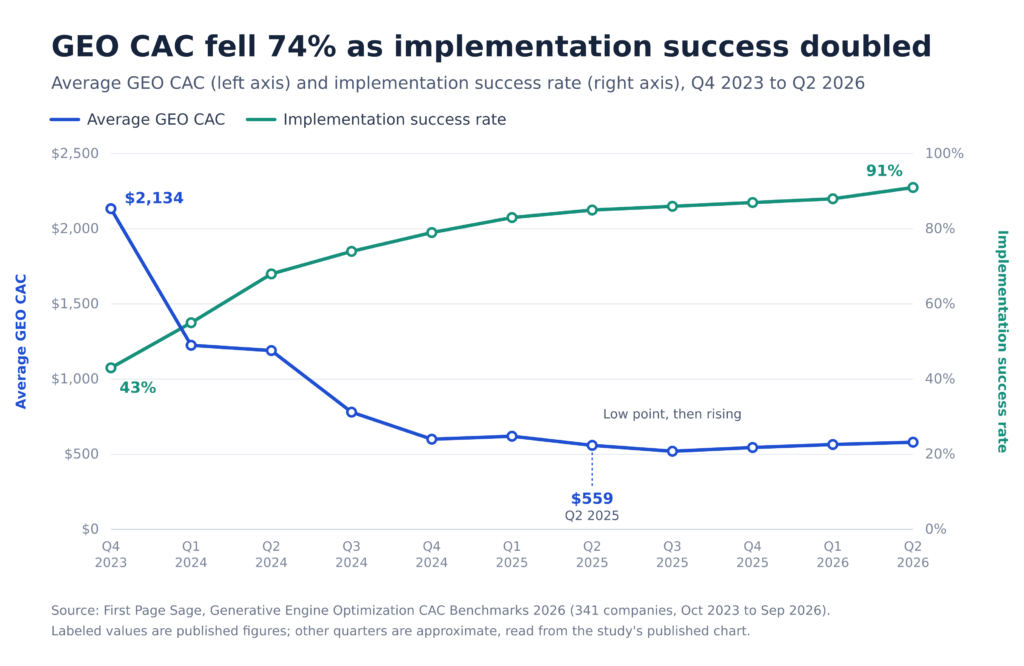
The early decline reflects a maturing discipline. Implementation success climbed from 43% in Q4 2023 to 91% in Q2 2026 as teams learned which content, entities and authority signals actually earn citations.
The recent uptick reflects competition. As more companies compete for visibility in AI answers, holding prominent placement demands stronger authority signals and more investment. Expect GEO CAC to keep drifting up, much like SEO CAC did as organic search matured.
How Do You Calculate GEO CAC?
Divide your total GEO spend for a period by the new customers attributed to AI answer engines in that same period. The hard part is not the math. It’s deciding what counts as spend and how to count customers honestly.
Here is an illustrative worked example for a mid-market B2B company (hypothetical numbers):
- Monthly GEO spend: $6,000 agency retainer + $500 prompt tracking tools + $1,500 digital PR and content + $1,000 internal time = $9,000
- AI-referred sessions: 1,800 per month
- Lead conversion rate: 3% = 54 leads
- Lead-to-close rate: 25% = 13.5 new customers
- Fully loaded GEO CAC: $9,000 ÷ 13.5 = $667
That $667 sits above the $581 average but inside the typical range for mid-market companies. Before you conclude GEO is underperforming, add in customers who report AI discovery on your forms (see attribution below), which often lowers the number meaningfully.
What costs belong in GEO CAC?
Include every cost that exists because of your AI visibility work. A useful checklist:
- Agency or consultant fees: agency GEO programs run from about $1,500 to $50,000+ per month depending on business size and scope WebFX
- Tools: AI visibility and prompt tracking platforms
- Content production: new pages, refreshes, comparison content and entity pages
- Digital PR and earned media: placements, ranked listicles, review generation on G2, Capterra and Trustpilot
- Technical work: structured data, JSON-LD, FAQPage schema, llms.txt and crawlability fixes for AI bots like GPTBot and PerplexityBot
- Internal salaries: the share of team hours spent on GEO
If a cost serves both SEO and GEO (a technical audit, for example), split it by estimated time or impact rather than dumping it all on one channel.
Blended vs fully loaded GEO CAC
Blended CAC usually counts only direct external spend like agencies, tools and content. Fully loaded CAC adds internal salaries, overhead and shared costs.
In the example above, blended GEO CAC is $8,000 ÷ 13.5 = $593, while fully loaded is $667. Report fully loaded CAC to finance, because it’s the number that actually reflects marketing efficiency. Use blended CAC internally to compare against agency-reported benchmarks, which rarely include your salaries.
How Do You Attribute Customers to AI Answer Engines?
Combine three signals, because no single one captures GEO’s full impact: a GA4 AI-referrer segment, self-reported attribution on your forms, and branded search lift. Each covers a blind spot the others miss.
Most teams skip this step entirely. Only 14% of marketers actually track AI search performance, and GA4 has no built-in AI traffic channel, so visits from ChatGPT, Perplexity and Gemini land in the general Referral bucket.
The flow you’re trying to capture looks like this:
AI citation → click or later branded search → conversion → CRM tag with AI source
The three signals:
- Referral traffic (GA4): captures buyers who click a citation link
- Self-reported attribution: a required “How did you hear about us?” field with “ChatGPT / AI assistant” as an option captures the dark funnel
- Branded search lift: rising branded queries in Google Search Console, correlated with citation gains, captures zero-click influence
For B2B, layer these into your multi-touch attribution model rather than replacing it. Add UTM parameters to any links you control in AI-indexed sources (directory listings, partner pages) so those visits are tagged cleanly.
How to set up an AI traffic channel in GA4
A GA4 custom channel group separates AI referrals from generic referral traffic in about ten minutes:
- Go to Admin → Data display → Channel groups.
- Copy the default channel group and name it “Default + AI Search.”
- Add a new channel called AI Search.
- Set the condition to Session source matches regex and paste:
.*(chatgpt\.com|chat\.openai\.com|perplexity\.ai|gemini\.google\.com|claude\.ai|copilot\.microsoft\.com|deepseek\.com|grok\.com).* - Drag AI Search above Referral in the channel order. GA4 applies rules top to bottom, so this step is essential.
- Save, then apply the new group in your acquisition reports.
Channel groups apply retroactively in reports, so you can see historical AI traffic immediately.
How to measure zero-click influence
Track citation share and share of voice in AI answers across a fixed set of buyer-intent prompts, then correlate those trends with branded search and direct traffic. You won’t get clean causation, but a consistent pattern is strong evidence.
A practical setup:
- Pick 15 to 30 buyer-intent prompts (for example, “best payroll software for startups”)
- Run them weekly across ChatGPT, Perplexity, Gemini, Claude, Copilot and Google AI Overviews
- Log whether you’re cited, your position and which sources the answer relies on
- Compare month-over-month citation share against branded search impressions in Search Console
Does GEO CAC differ by AI platform?
Yes, because traffic volume and conversion quality vary sharply by platform. SE Ranking’s 2026 data shows ChatGPT sending 74.78% of AI referral traffic, followed by Gemini at 11.56%, Perplexity at 7.23%, Copilot at 3.51% and Claude at 2.62%.
B2B looks different. Goodie’s brand-averaged data for March and April 2026 put ChatGPT at 62.6% of B2B AI referrals, Claude at 18.5%, Gemini at 10.6% and Perplexity at 7.3%. The gap between the two studies comes from sample differences, which is exactly why you should measure your own mix.
Conversion rates also differ. Seer Interactive measured ChatGPT referrals converting at 15.9%, Perplexity at 10.5% and Claude at 5.0%. Segment your GA4 AI channel by source to calculate CAC per platform, then weight your optimization toward the engines your buyers actually use. Authoritytech
What Is a Good LTV:CAC Ratio and Payback Period for GEO?
Aim for the same 3:1 LTV:CAC ratio you’d target for any channel, with a payback period under 12 months. GEO compares well here: the First Page Sage benchmark shows payback of about 3 to 5 months depending on company size.
GEO can also lift the LTV side of the ratio. Reuters reported that AI-referred shoppers generate 41% higher revenue per visit than shoppers from traditional channels. If that holds for your business, a higher CAC can still produce a better ratio.
| Channel | Benchmark CAC | What it means for payback |
|---|---|---|
| Traditional SEO | $470 | Lowest CAC, but slowest to convert (84 days) |
| GEO | $581 | Moderate CAC, faster conversion, 3 to 5 month payback |
| Google Ads | $781 | Fastest results, highest CAC, value stops when spend stops |
Payback matters to investors too. Companies with CAC payback over 18 months at Series B show a 43% higher likelihood of down-rounds, so a short-payback channel like GEO strengthens your efficiency story. Ltvcacbook
What Drives GEO CAC Up or Down?
The three biggest levers are citation share on buyer-intent prompts, the conversion rate of the pages AI engines cite, and third-party authority. Improve any one and CAC falls without extra spend.
- Citation share on buyer-intent prompts (lowers CAC): being cited for “best X for Y” queries reaches buyers at decision stage.
- Conversion rate of cited pages (lowers CAC): AI engines often cite blog posts or comparison pages, not your product page. If those pages have weak CTAs, you waste warm traffic.
- Third-party authority (lowers CAC): AI models built on retrieval-augmented generation (RAG) lean on reviews, Reddit and community mentions, ranked listicles, press coverage and Wikipedia/Wikidata to decide who to recommend.
- Entity clarity (lowers CAC): consistent entity pages and structured data help models place you correctly in their knowledge graph.
- Competitive density (raises CAC): more brands competing for the same prompts means more investment to hold your spot.
- Organizational friction (raises CAC): slow approval cycles delay publishing and push payback out.
- Blocked AI crawlers (raises CAC): if your robots.txt blocks GPTBot or PerplexityBot, you’re invisible to the engines you’re paying to rank in.
How Can You Lower Your GEO CAC?
Start where warm traffic already exists, then build authority outward. This playbook is ordered by impact for most teams:
- Pick 15 to 30 buyer-intent prompts. Focus on the questions a buyer actually asks ChatGPT before reaching out, not vanity terms. DoodleWeb
- Fix conversion on pages AI engines already cite. Add clear CTAs, pricing context and demo paths to your most-cited URLs. This is often the fastest CAC win.
- Earn third-party mentions. Pursue review volume on G2, Capterra and Trustpilot, inclusion in ranked listicles, and authentic participation on Reddit and industry communities.
- Build entity pages and structured data. Publish clear About, product and comparison pages with JSON-LD and FAQPage schema so models can extract facts cleanly.
- Confirm crawlability. Allow AI bots, keep key content in HTML rather than images or scripts, and consider an llms.txt file.
- Refresh quarterly. AI engines favor current, specific information. Update statistics and dates on high-value pages every quarter.
- Track and reallocate monthly. Move effort toward the prompts and platforms producing customers, not just citations.
Are GEO CAC Benchmarks Reliable?
Treat GEO CAC benchmarks as directional, not definitive. The channel is young, measurement is immature, and the underlying platforms change month to month.
Keep these caveats in mind:
- Most data comes from agencies measuring their own clients. That creates selection bias toward successful programs.
- Attribution undercounts GEO. Zero-click influence and the dark funnel mean true CAC is likely lower than reported, but by an unknown margin.
- AI referrals don’t win everywhere. A 12-month study of 973 websites by Schulze and Kaiser found ChatGPT referrals underperformed Google organic on transactional purchases by about 13%, with AI traffic doing better in research-heavy verticals and worse in impulse categories like apparel and grocery. QuickSEO
- Platform share is shifting fast. Gemini and Claude are gaining ground, so a benchmark built on 2025 traffic patterns may not reflect your 2026 mix.
The fix is to baseline your own GEO CAC for 90 days using the three-signal model before comparing against any published benchmark. Your own trend line is more valuable than anyone’s average.
Frequently Asked Questions
Is generative engine optimization CAC higher than SEO?
Is GEO worth it for small businesses?
Often, yes. Small businesses posted the lowest GEO CAC in the 2026 benchmark at $494, with payback in about four months. Smaller brands move faster and carry less legacy content, which helps AI models understand them quickly. Start with a focused prompt list and low-cost tools before committing to a large retainer.
How long until GEO lowers CAC?
Expect roughly two to seven months, depending on how you execute. In the First Page Sage data, premium agency programs showed results in about 52 days, while in-house-only programs took around 203 days. Early wins usually come from improving conversion on pages AI engines already cite, not from new content.
Which AI platform sends the highest-converting traffic?
It depends on your audience. Seer Interactive measured ChatGPT referrals converting at 15.9% and Perplexity at 10.5%, while Claude's share of B2B referrals has grown quickly in 2026. ChatGPT sends the most volume overall. Segment your GA4 AI channel by source to find which platform produces your cheapest customers.
The Bottom Line on Generative Engine Optimization Customer Acquisition Cost in 2026
Generative Engine Optimization Customer Acquisition Cost averages about $581 in 2026, sitting between traditional SEO ($470) and paid channels like Google Ads ($781). It ranges from roughly $265 to $1,129 by industry and rises with company size.
What the averages hide matters more than the averages. GEO delivers the highest-quality leads of any channel measured, pays back in months, and is almost certainly undercounted by last-click analytics.
Your next step: set up a GA4 AI channel, add AI to your “How did you hear about us?” field, and track branded search lift for 90 days. Then compare your number to these benchmarks with confidence.