
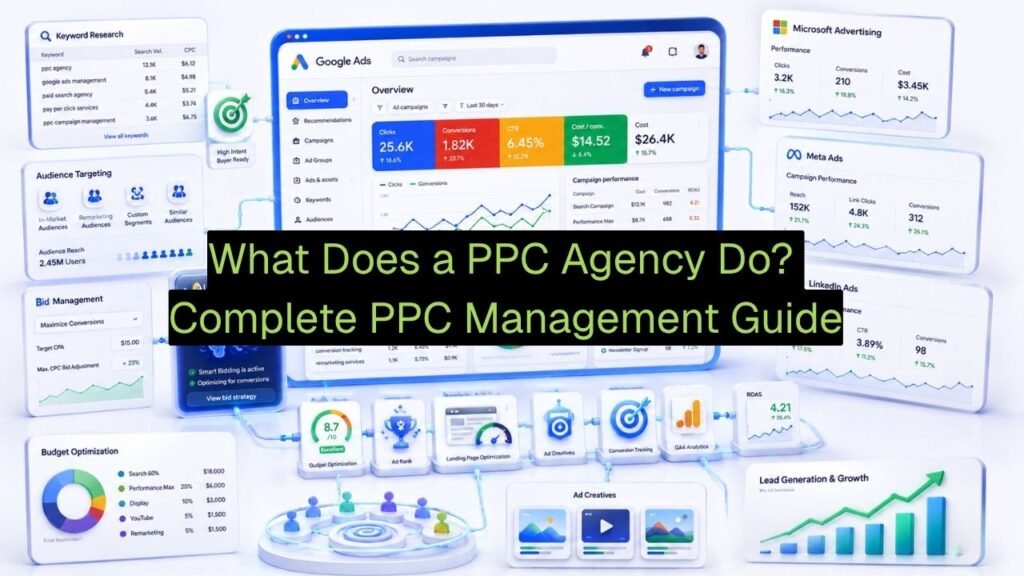
A PPC agency runs paid advertising campaigns on your behalf — building, launching, and managing paid search and paid social ads on platforms like Google Ads or Meta so your business shows up in front of people actively searching for what you sell. You pay the agency a fee to manage the account; you pay the ad platform separately for the clicks or impressions themselves.
That second sentence is where most confusion starts, and it’s exactly where this guide begins.
What Is a PPC Agency? (The Direct Answer)
A PPC agency is a specialist that plans, builds, and optimizes pay-per-click advertising campaigns for a business, typically across Google Ads, Microsoft Advertising, and paid social platforms like Meta or LinkedIn. The agency handles keyword research, ad copy, bid management, and reporting, while the business pays for ad spend separately from the agency’s management fee.
Everything below breaks down what that actually looks like week to week.
What Does a PPC Agency Actually Do?
The work splits into a handful of concrete responsibilities. A capable agency touches all of them; a weak one tends to set a campaign live and check back once a month.
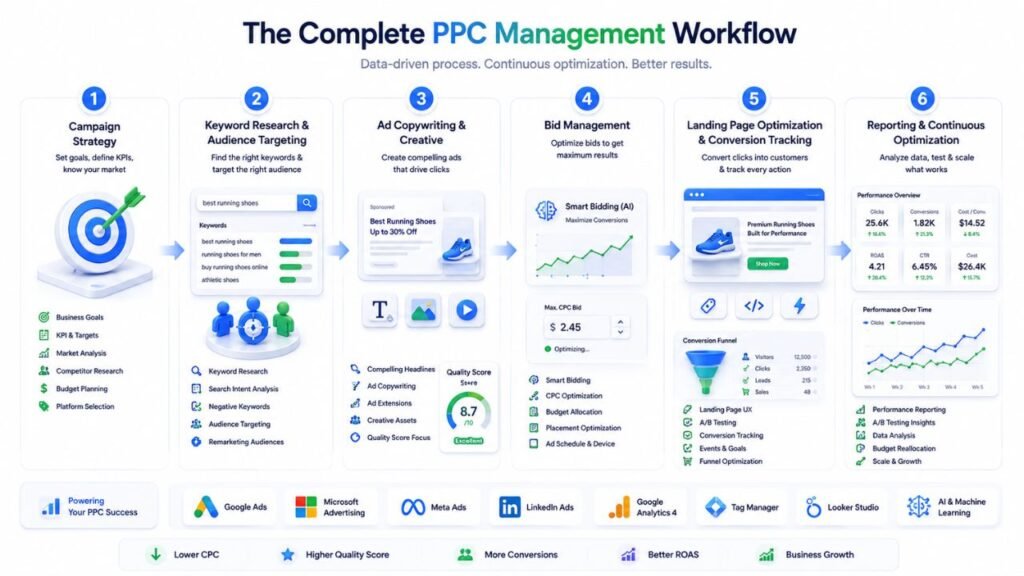
Campaign Strategy and Platform Selection
Before any ad goes live, a PPC agency decides where the budget actually belongs. Not every business benefits from every platform — a B2B software company chasing decision-makers behaves nothing like a local retailer chasing foot traffic, and the account structure built around each one looks different from day one.
Keyword Research and Audience Targeting
For search campaigns, this means identifying the exact terms a buyer types into Google, then building out negative keywords — the terms you specifically want to exclude — so the budget doesn’t get wasted on searches that will never convert. For social platforms, the equivalent work is audience targeting: narrowing a campaign down to the job titles, interests, or behaviors that actually match a business’s customer, often paired with remarketing (also called retargeting) campaigns aimed at people who already visited the site but didn’t convert.
Ad Copywriting and Creative
Every ad needs copy that earns a click without misleading the person clicking it. This is also where quality score comes into play on Google Ads — a metric that weighs how relevant your ad and landing page are to the keyword, and one that directly affects how much you pay per click.
Bid Management and Budget Optimization
Someone has to decide how much to bid for each keyword or placement, and adjust that bid as performance data comes in. Most agencies today lean on Smart Bidding, Google’s machine-learning bid strategy that automatically adjusts bids toward a target outcome — but automation still needs a human checking that the target itself is set correctly.
Landing Page Alignment and Conversion Tracking
An ad that gets clicks but sends traffic to a slow, unrelated, or confusing landing page is money burned. A competent agency reviews — and often rebuilds — the page a campaign points to, then sets up conversion tracking so every form fill, call, or purchase can be traced back to the exact ad that caused it. [Internal link: /web-development/]
Reporting and Ongoing Optimization
Campaigns aren’t “set and forget.” A/B testing on headlines, images, and landing page elements should run continuously, with attribution data feeding back into weekly or monthly decisions about where budget shifts next.
Which Platforms Does a PPC Agency Manage?
Most agencies claim expertise across every platform. Few actually have it, and that gap matters more than most people realize before hiring one.
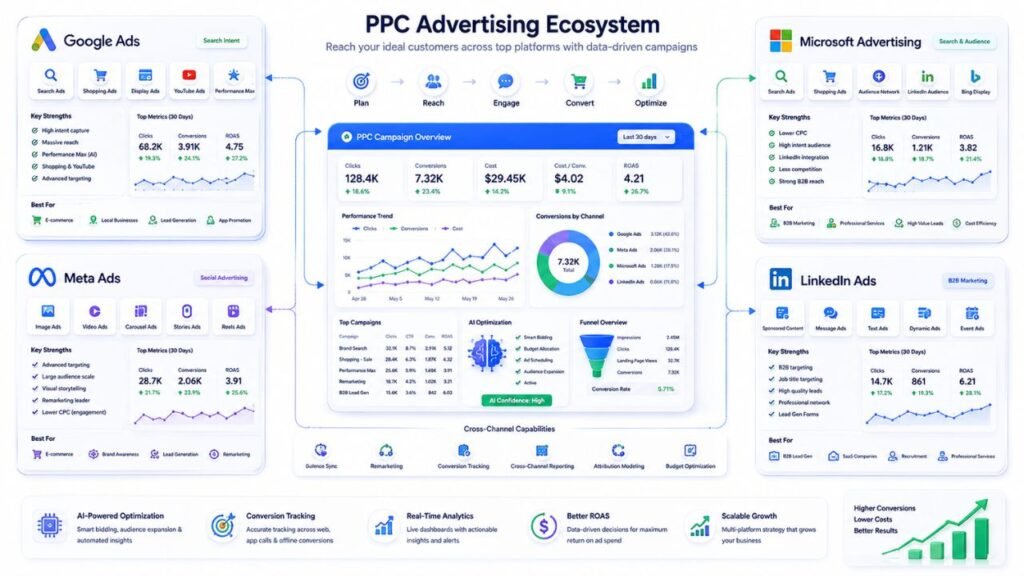
Google Ads is the default starting point for most PPC programs, covering Search, Shopping, Display advertising, and YouTube Ads under one account. A retailer with a physical catalog will typically add Google Shopping into that mix for product-level visibility. Performance Max, Google’s newer automated campaign type, blends several of these formats into a single campaign — powerful when set up correctly, and a common source of wasted spend when it isn’t. Agencies managing Google Ads typically work inside Google Ads Editor for bulk changes, alongside Google Analytics (GA4) and Google Search Console for tracking what happens after the click.
Microsoft Advertising, still commonly called Bing Ads, reaches a smaller but often less competitive audience — and for certain B2B and older-demographic audiences, cost per click can run meaningfully lower than Google’s.
Paid social — Meta Ads, LinkedIn Ads, and others — operates on a different logic than search. Instead of capturing existing demand the way Google Ads does, social platforms create demand by interrupting a scroll with an ad. LinkedIn Ads tends to fit B2B lead generation better than most other platforms, given its targeting by job title and industry, while Meta typically suits consumer-facing businesses with a visual product.
The honest takeaway: an agency that’s genuinely strong in Google Ads and weak everywhere else is common, and that’s not automatically a problem — it’s a problem only if they’re claiming otherwise.
How Much Does a PPC Agency Cost?
This is the least transparent part of the industry, and it doesn’t need to be.
Percentage of Ad Spend vs. Flat Retainer vs. Performance-Based
Agencies price their management fee — separate from what you spend on the ads themselves — in three common ways:
- Percentage of ad spend. Usually 10–20% of monthly budget. Scales naturally with account size, but can create a mismatch: an agency earning more as your spend goes up doesn’t always have an incentive to find efficiencies that shrink the budget.
- Flat monthly retainer. Often $1,000–$10,000+ depending on account complexity. Keeps costs predictable regardless of spend, which tends to suit businesses that want their management fee to stay stable as ad spend fluctuates seasonally.
- Performance-based pricing. Fees tied to leads generated or revenue attributed to the campaign. Attractive in theory, but it puts pressure on the agency to optimize for whatever metric triggers payment, which isn’t always the metric that matters most to the business.
What’s Included (and What Isn’t) at Different Budget Levels
A smaller retainer typically covers campaign setup, basic keyword research, and monthly reporting. Larger retainers add landing page testing, multi-platform management, and more frequent optimization cycles. Neither is inherently better — the right fit depends on how much is actually being spent on ads and how complex the account needs to be.
Management Fees vs. Ad Spend — Why the Distinction Matters
This is worth repeating plainly: a $2,000/month management fee and a $2,000/month ad budget are two entirely different numbers that happen to look identical on a page. Before signing anything, ask an agency to state both figures separately, in writing. Any proposal that blends the two into one vague “investment” number is worth a second look.
PPC Agency vs. In-House Management vs. Freelancer
This decision gets skipped by most agency content, which jumps straight from “here’s what PPC is” to “here’s why you should hire us.” It deserves a straight answer instead.
In-house management makes sense once ad spend is large enough, and campaigns complex enough, to justify a full-time hire with benefits and ongoing platform training. It gives full control and institutional knowledge of the business, at the cost of higher fixed overhead and a narrower skill set than a team of specialists could offer.
A freelancer works well for a single, well-scoped campaign or a smaller budget where a full agency retainer wouldn’t be justified. The tradeoff is coverage — one person managing one platform, with less redundancy if they’re unavailable and typically no in-house creative or landing page support.
A PPC agency fits businesses that need multiple platforms managed together as one coordinated campaign management effort, want access to a team — strategist, ad copywriter, analyst — for less than the cost of one senior in-house hire, and value benchmarks pulled from managing other accounts. The tradeoff is less day-to-day control and a real need to vet the agency’s actual platform depth rather than trusting a services list at face value.
None of these three is the universally right answer. The right one depends on budget, internal bandwidth, and how many platforms genuinely need to run at once.
How to Choose a PPC Agency
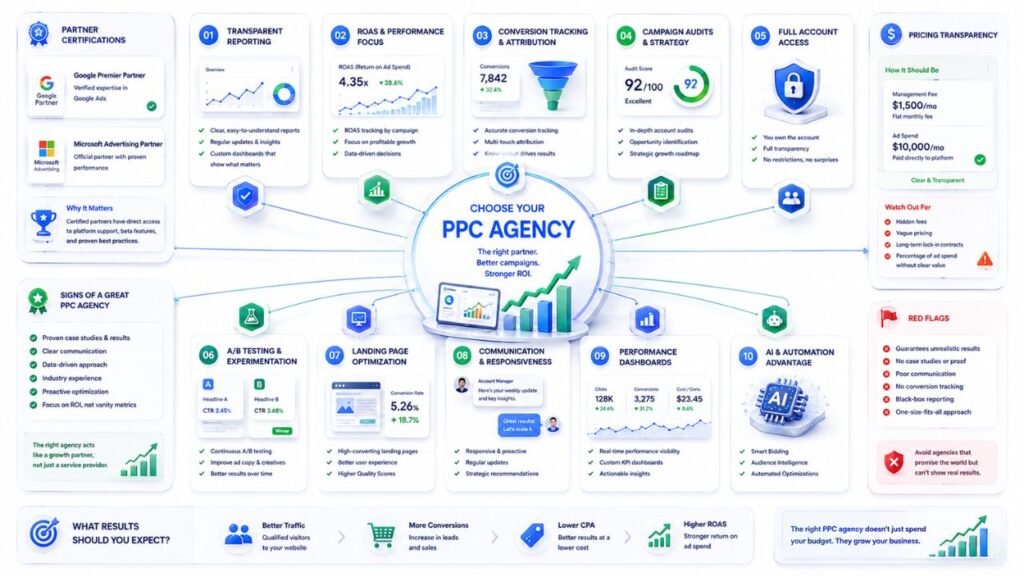
Google Premier Partner and Microsoft Advertising Partner Status — What It Actually Means
These badges show up on nearly every agency’s homepage, and few explain what earning one requires. Google Partner status requires an agency to maintain a minimum level of managed ad spend, pass Google Ads certification exams, and hit performance benchmarks across client accounts; Google Premier Partner sits above that, reserved for a smaller tier of agencies meeting higher spend and performance thresholds. Microsoft Advertising Partner works on a similar logic for Bing Ads. The badge is a real signal of platform competency — it’s not, on its own, a guarantee of good communication, honest reporting, or a strategy that fits your specific business.
Questions to Ask About Reporting and Attribution
Ask what gets reported monthly, and ask to see a sample report before signing anything. A credible agency will show cost per lead, conversion rate, and ROAS trends over time — not just clicks and impressions dressed up in a polished template. Ask, too, how they handle attribution when a customer’s path involves more than one channel; a straight answer here says more about an agency’s competence than almost anything else they’ll tell you.
Red Flags That Signal Wasted Ad Spend
A few warning signs show up consistently in accounts that have been mismanaged:
- Broad match keywords left unchecked, pulling in irrelevant searches without a negative keyword list trimming them back
- Reporting that highlights clicks and impressions but never mentions cost per lead or ROAS
- No shared access to the actual ad account or analytics dashboard — only a PDF summary the agency controls
- Landing pages that haven’t changed since setup, with no A/B testing on record
- Vague answers when asked directly what the management fee is, separate from ad spend
Any one of these alone isn’t necessarily disqualifying. Two or three together are worth walking away from.
Common PPC Mistakes Agencies (and Businesses) Make
Some of these sit on the agency side, some on the client side, and the account usually suffers regardless of which one caused it.
- Treating PPC and SEO as competitors instead of complements. PPC delivers fast, rented visibility that disappears the moment spending stops; SEO builds slower, owned organic traffic that persists without ongoing ad spend. Search engine marketing (SEM) covers both under one strategic umbrella, and most mature accounts run them together rather than picking one. [Internal link: /seo/]
- Ignoring the landing page. Ad quality and landing page quality are inseparable — sending traffic to a page that wasn’t built for conversion rate optimization wastes a click that was already paid for.
- Setting a campaign live and walking away. PPC rewards continuous attention. Bid strategies, keyword lists, and ad creative all degrade in performance over time without regular review.
- Judging performance by clicks alone. Clicks are an input, not an outcome. A campaign can drive more clicks and fewer actual conversions at the same time, especially once broad match keywords start pulling in low-intent traffic.
- Skipping conversion tracking setup entirely. Without it, there’s no way to know which keywords, ads, or platforms are actually driving revenue — every reporting conversation becomes guesswork.
What Results Should You Expect, and By When?
How Fast Does PPC Actually Work?
PPC is the fastest channel in digital marketing to produce data, though “fast” doesn’t mean “optimized.” Most campaigns go live and start generating clicks within days, but the first two to four weeks are typically a testing period — refining keywords, audiences, and ad copy based on early performance. Cost per lead usually starts stabilizing by month two or three, once enough data has accumulated for bid strategies to work with.
Metrics That Matter — CPC, CTR, ROAS, and Cost Per Lead
Cost per click (CPC) and click-through rate (CTR) are useful early indicators of ad relevance, but neither tells you whether the campaign is actually working. Return on ad spend (ROAS) and cost per lead are the metrics that connect spend to business outcomes, and a good agency should be able to show a clear trend line on both, tied back to an overall return on investment (ROI) figure — not just a single snapshot number pulled from the best week of the quarter.
Frequently Asked Questions
What does a PPC agency do?
How much does a PPC agency charge?
Is it worth hiring a PPC agency?
What's the difference between PPC and SEO?
How long does it take to see results from PPC?
What is a Google Premier Partner?
Do I need a separate agency for Google Ads and social ads?
What's a good cost per click?
Can I run PPC myself instead of hiring an agency?
What is ROAS and why does it matter?
Is a PPC Agency Right for Your Business?
If your business already has a working landing page, a clear idea of who converts, and enough monthly ad budget to make management fees worth paying, a PPC agency is usually the fastest way to turn that budget into qualified leads without spending months learning three different ad platforms yourself. For a business with a physical presence — a clinic near the Texas Medical Center, a service company covering Katy and Sugar Land, or a B2B firm based in Houston’s Energy Corridor — pairing PPC with a fully built-out Google Business Profile tends to sharpen local targeting even further.
If you’re still deciding whether that describes your situation in Houston, Texas, or anywhere else, a free account audit is a lower-commitment way to find out than signing a retainer. Get a free PPC audit and see where your current campaigns — or your first one — actually stand.