A B2B digital marketing agency helps companies sell to other companies — through SEO, paid ads, content, and email — instead of chasing individual consumers. That single distinction changes almost everything about how the work gets done, who it’s aimed at, and how you should judge whether it’s working.
Most agency websites won’t tell you that plainly. They’ll show you a wall of client logos and a stock photo of people pointing at a whiteboard, and leave you to guess what you’re actually buying. This guide skips that part. It covers what these agencies do, what separates B2B marketing from B2C, what a fair price looks like, and the questions worth asking before you sign a retainer.
What Is a B2B Digital Marketing Agency?
A B2B digital marketing agency builds and runs marketing programs for companies that sell products or services to other businesses rather than to individual shoppers. The client might be a SaaS company selling software subscriptions, a manufacturer selling industrial equipment, or a professional services firm selling consulting hours. Most of this work falls under demand generation — building enough awareness and interest that qualified buyers enter the pipeline in the first place, rather than waiting for them to show up on their own. The buyer on the other end isn’t a person shopping for themselves — it’s an employee spending someone else’s budget on behalf of an organization.
That reframes the agency’s job. Instead of optimizing for impulse and emotion, the work centers on trust, proof, and patience. A B2B agency typically runs SEO, PPC, content marketing, email, and web design, but tunes every one of those channels around a buyer who researches for weeks or months before ever picking up the phone.
How B2B Marketing Differs from B2C Marketing
B2C marketing sells to one person making a fast, often emotional decision — think of an ad for shoes or a meal-kit subscription. B2B marketing sells to a group of people making a slow, risk-averse decision on behalf of their employer. A consumer buying a jacket doesn’t need a demo, a security review, or sign-off from their manager. A procurement director buying software often needs all three.
That’s why B2B campaigns lean on data sheets, case studies, and long-form content instead of lifestyle imagery. The goal isn’t a single click-to-cart moment — it’s building enough confidence, over enough touchpoints, that a buying committee agrees the risk of choosing you is lower than the risk of choosing a competitor or doing nothing.
Who Actually Hires a B2B Digital Marketing Agency
The companies that hire these agencies tend to share a few traits: a sales cycle measured in weeks or months rather than minutes, a product or service with a real price tag attached, and more than one person involved in the final yes. That describes SaaS companies, manufacturers, logistics providers, healthcare vendors, legal services firms, and industrial or B2B services companies of nearly every size.
It also describes a category people forget: home services and commercial contractors who sell to other businesses, not homeowners — a commercial roofing company bidding on office buildings, for example, is running a B2B sales process even though “home services” sounds consumer-facing on the surface.
What Services Does a B2B Digital Marketing Agency Provide?
Most full-service agencies offer a similar menu. What separates a good one isn’t the list — it’s how each channel gets adapted for a business buyer instead of a consumer.
SEO for B2B. Search engine optimization for a B2B company means ranking for the specific, often unglamorous terms a buyer types while comparing vendors — not high-volume terms with no purchase intent behind them. That work splits into on-page SEO (page structure, keyword targeting, internal linking), technical SEO (site speed, crawlability, structured data), and, for companies with a physical office or service area, local SEO layered on top. [Internal link: /seo/]
PPC for B2B lead generation. Pay-per-click campaigns on Google Ads and LinkedIn Ads put your company in front of the exact job titles and industries in your target list, often before they’ve started actively searching. For B2B, the win isn’t traffic volume — it’s cost per qualified lead and, ultimately, cost per opportunity that reaches sales. [Internal link: /ppc-agency/]
Content marketing and thought leadership. Long sales cycles run on information. Blog posts, whitepapers, and guides that answer real questions a buyer has mid-research do more to move a deal forward than a sales call ever could at that stage — and they double as the raw material for SEO and email nurturing.
Web design and conversion optimization. A B2B website’s job is to convince a stranger, in about ninety seconds, that your company understands their problem well enough to be trusted with it. That’s a UX and conversion rate optimization (CRO) problem as much as a design one — the site needs to load fast, explain the offer clearly, and make it obvious what to do next. [Internal link: /web-development/]
Email marketing and lead nurturing. Most B2B buyers aren’t ready to talk to sales the first time they visit your site. Email marketing, often run through a marketing automation platform, keeps a lead warm — sending relevant content on a schedule until they’re further along the buyer journey and worth a sales conversation. Most of this is inbound work, though some agencies pair it with outbound marketing — targeted cold email or LinkedIn outreach to accounts that haven’t engaged with your content yet. [Internal link: /email-marketing/]
Social media marketing, LinkedIn first. B2B social rarely behaves like B2C social. Reach and follower counts matter less than whether the right decision-makers see your content in a feed built around their job function. LinkedIn dominates B2B social for exactly that reason — it’s the one platform where audiences are already segmented by title, company, and industry. [Internal link: /social-media-marketing/]
Account-based marketing. ABM flips the usual funnel: instead of casting a wide net and filtering down, the agency picks a specific list of target accounts and builds a coordinated campaign — ads, content, outreach — aimed at that list alone. It’s a genuinely different discipline from broad-based inbound marketing, and worth asking a prospective agency about directly rather than assuming every “full-service agency” runs it well.
How B2B Marketing Actually Differs From B2C (In Practice)
The theory is easy to state. Here’s what it actually changes about the day-to-day work.
Longer, Committee-Driven Sales Cycles
A B2C purchase can close in seconds. A B2B sale often takes three to eighteen months, depending on price and complexity. That means a single ad or blog post rarely closes a deal on its own — it’s one touchpoint in a sequence that might include a dozen others before a contract gets signed. Agencies that understand B2B build campaigns around that timeline instead of expecting instant conversions.
Multiple Decision-Makers, Not One Buyer
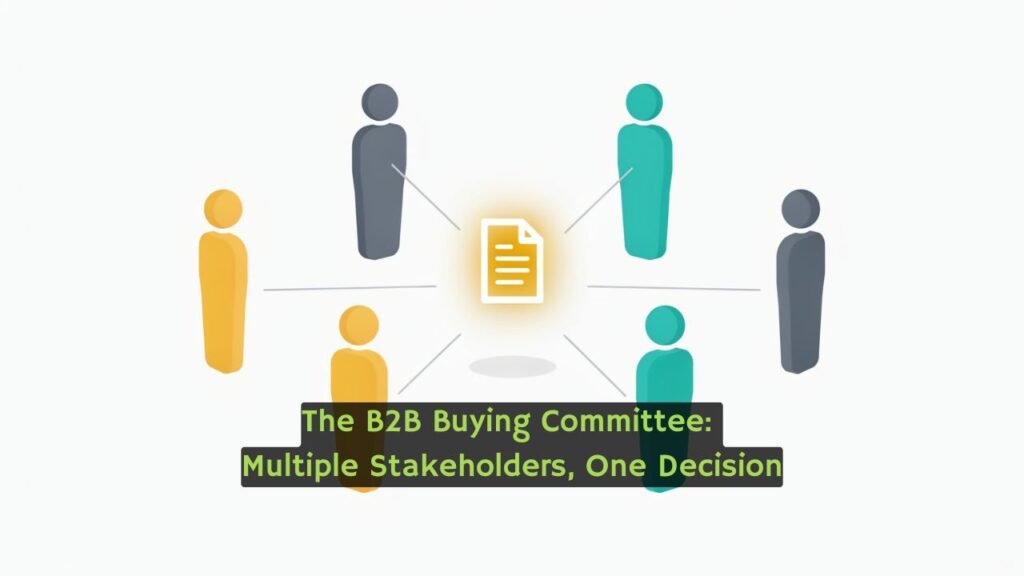
Enterprise software deals can involve a buying committee of six or more people: an end user, a department head, IT, finance, legal, and an executive sponsor. Each one weighs different things — the end user cares about usability, finance cares about total cost, IT cares about security. Content and messaging built for a single consumer buyer misses most of that committee entirely. Good B2B content marketing speaks to more than one stakeholder at once, sometimes in the same piece.
Lead Quality Over Lead Volume
A B2C funnel often optimizes for the largest number of cheap leads. A B2B funnel does the opposite on purpose. A hundred unqualified form-fills that never match the company’s ideal customer profile (ICP) waste sales team time and inflate customer acquisition cost (CAC) without producing revenue. The better benchmark is how many marketing-qualified leads (MQLs) turn into sales-qualified leads (SQLs) as they move through the sales funnel, and how many of those become real pipeline.
What Does a B2B Digital Marketing Agency Cost?
Most agency websites dodge this question entirely. Here’s a straight answer, with the caveats that make it accurate.
Project-Based vs. Retainer Pricing
A one-off project — a new website, a single campaign — usually gets priced as a flat fee based on scope. Ongoing work like SEO, PPC management, or content production almost always runs on a monthly retainer, because those channels compound over time and need continuous management rather than a single deliverable.
For small to mid-market B2B companies, realistic retainer ranges tend to land in the following bands:
- Single-channel management (SEO only, or PPC only): roughly $700–$2,500/month for a starter engagement, scaling toward $2,000–$4,000+/month as scope and competitiveness grow.
- Multi-channel programs (SEO plus content, or SEO plus PPC): commonly $1,300–$3,000+/month depending on volume of content and ad spend managed.
- Full-service programs spanning SEO, paid media, content, and reporting: often $2,500–$10,000+/month, with enterprise engagements running considerably higher.
These ranges shift with company size, industry competitiveness, and how much the agency is asked to produce each month — a 25-blog-post-a-month SEO program costs more than a 5-post-a-month one, independent of any other variable.
What Actually Affects the Price
Three things move the number more than anything else: how many channels are in scope, how competitive your industry’s search terms are, and how much content or ad spend the agency is managing on your behalf. A manufacturer competing for a handful of low-volume, low-competition keywords will pay less than a SaaS company competing for the same crowded terms as fifty other well-funded startups.
Red Flags in Pricing
Walk carefully around any agency that won’t put a number, or at least a range, in writing before a sales call. Same goes for scopes of work that list channels but not deliverables — “SEO services” with no stated number of pages, posts, or hours attached is a scope that can quietly shrink the moment the contract is signed. A clear reporting cadence, a stated deliverable count, and a defined minimum commitment period are the three things a fair contract should always include.
How to Choose the Right B2B Digital Marketing Agency
This is a hire, not a purchase — treat it like one.
Ask for B2B-Specific Case Studies, Not Just Logos
A logo wall proves an agency has clients. It doesn’t prove they understand your kind of sale. Ask specifically for a B2B example: what was the sales cycle length, what channels were used, and what happened to pipeline or revenue, not just traffic. An agency with real B2B experience will have that answer ready without hesitation.
Understand Their Reporting and Attribution Model
Ask what gets reported monthly and how they connect marketing activity to actual revenue. Attribution in B2B is messier than in B2C because deals touch so many channels before closing — a credible agency will explain how they handle that mess rather than pretending it doesn’t exist. If a CRM like HubSpot or Salesforce is already part of your stack, ask directly whether they’ve worked inside it; the answer tells you a lot about how seriously they take attribution.
Check Industry or Vertical Experience
An agency that has run campaigns for SaaS, professional services, manufacturing, logistics, healthcare, or legal services companies will already understand the compliance constraints, buyer language, and typical sales cycle of that industry. That’s not mandatory — a sharp generalist agency can ramp up quickly — but it does shorten the learning curve, and it’s fair to ask about directly.
In-House vs. Full-Service Agency vs. Freelancer
This is the comparison most agency pages skip, because it’s the one where “hire us” isn’t automatically the right answer.
- In-house team. Best when marketing is core to the business and you can afford several specialized hires — an in-house team gives you full control and institutional knowledge, at the cost of higher fixed overhead and a narrower skill set than an agency can offer.
- Freelancer or small contractor. Works well for a single, well-defined channel (one freelance SEO consultant, one PPC specialist) at a lower price point, but rarely covers multiple channels well and depends heavily on one person’s availability.
- Full-service agency. Fits companies that need several channels working together — SEO, PPC, content, email — without hiring a full internal team for each one. The tradeoff is less day-to-day control and a need to vet the agency’s actual bench strength, not just its sales pitch.
None of these is universally correct. The right choice depends on budget, how many channels you need running at once, and how much internal marketing capability you already have.
Common Mistakes Businesses Make When Hiring a B2B Agency
A few patterns show up again and again in failed agency relationships:
- Hiring for price instead of fit. The cheapest retainer is rarely the cheapest outcome once wasted spend and missed timelines are counted.
- Skipping the ICP conversation. An agency that never asks who your ideal customer profile actually is will build campaigns aimed at “anyone,” which in B2B means aimed at no one in particular.
- Judging success by traffic alone. Traffic is an input, not an outcome. A campaign can drive more visitors and fewer qualified leads at the same time.
- No agreed reporting cadence. Vague promises of “monthly updates” without a defined format leave you unable to tell whether the program is actually working.
- Expecting B2C timelines. A campaign that hasn’t produced pipeline in month one isn’t automatically failing — B2B sales cycles are long, and judging a program too early leads to premature agency-hopping.
- Ignoring sales-marketing alignment. If marketing generates leads and sales never follows up, or the two teams define “qualified” differently, no agency can fix that from the outside. It has to be solved internally first.
What Results Should You Expect, and By When?
Realistic SEO Timelines for B2B
Organic search results build slowly by design. Most B2B SEO programs start showing measurable movement — new keyword rankings, early traffic gains — around the four-to-six-month mark, with meaningful lead flow typically arriving between months six and twelve. Highly competitive industries or brand-new websites with no existing authority often sit at the longer end of that range. Any agency promising first-page rankings inside thirty days is either inexperienced or not being straight with you.
What “Good” Looks Like for PPC and Paid Lead Gen
Paid channels move faster. Google Ads and LinkedIn Ads campaigns can start generating leads within the first few weeks, though the first month or two typically involves testing — refining keywords, audiences, and ad copy until cost per lead stabilizes. A well-run B2B paid program should show a clear, improving trend in cost per marketing-qualified lead by the second or third month, not a flat or worsening one. That trend should be visible in your own Google Analytics dashboard, not just an agency’s internal report — if a prospective agency hesitates to give you direct access to your own analytics and Google Search Console data, treat that as a warning sign.
Setting KPIs That Actually Matter
Traffic and impressions are easy to report and easy to inflate. The metrics that actually reflect a healthy B2B program sit further down the funnel: MQL-to-SQL conversion rate, cost per opportunity, sales cycle length, and — the number that ultimately matters most — marketing’s contribution to closed pipeline. Return on investment (ROI) should be measured against those figures, not against vanity metrics that look good in a slide deck and mean little to a sales team.
Why Businesses Choose B2B Allies
B2B Allies runs full-service digital marketing — SEO, PPC, social media, email marketing, web development, and graphic design — for businesses in and around Houston, including companies based near Katy, Sugar Land, and the wider Texas market. The agency’s client base spans local service businesses, professional firms, and B2B companies that need consistent lead flow rather than one-off campaigns.
What tends to matter most to clients evaluating an agency also happens to be where B2B Allies is most direct: pricing is published in tiers rather than hidden behind a “request a quote” form, reporting is monthly and specific rather than vague, and the process — discovery, strategy, execution, optimization, reporting — is the same regardless of company size. For a business trying to decide between building an in-house team, hiring a freelancer, or bringing on a full-service agency, that kind of transparency is worth weighing heavily, since it’s exactly what disappears once a contract is signed with a less forthcoming shop.
Frequently Asked Questions
What is B2B digital marketing?
What is the difference between B2B and B2C digital marketing?
How much does a B2B marketing agency cost per month?
What is the best marketing channel for B2B companies?
Do B2B companies need SEO?
How do I measure ROI from a B2B marketing agency?
The Next Step
If you’re evaluating agencies right now, start with the questions in the “How to Choose” section above before a single sales call — case studies, reporting model, and vertical experience. Then compare the answer against a clear scope and price, not a vague promise.
B2B Allies publishes its pricing and process for exactly that reason. If you’d rather skip the vetting and just talk through what a program would look like for your business, get a free quote and start there.